Warranties and Indemnities in Business Acquisitions: What They Are, What They Protect, and How to Negotiate Them
Warranties and indemnities are the legal mechanism through which the risk of unknown and undisclosed problems in an acquired business is allocated between buyer and seller after completion. They are among the most heavily negotiated provisions in any share purchase agreement, and among the least well understood by buyers and sellers who have not been through the process before.
Most people who have heard the term assume warranties and indemnities are primarily legal formalities — something the lawyers argue about while the principals focus on the commercial terms. That is a significant misunderstanding. The warranty and indemnity package in an SPA has direct and material financial consequences. A seller who agrees to overly broad warranties with inadequate limitation provisions has ongoing financial exposure that they may not have priced into the deal. A buyer who accepts a heavily qualified warranty package with a short limitation period has limited recourse if material problems surface post-completion.
This post demystifies the subject — explaining what warranties and indemnities are, how they differ, why they matter, and how to approach the negotiation of them as both buyer and seller. It is not a substitute for specialist legal advice on a specific transaction, but it will ensure you arrive at that conversation understanding what you are negotiating and why.
What Warranties Are (And What They Are Not)
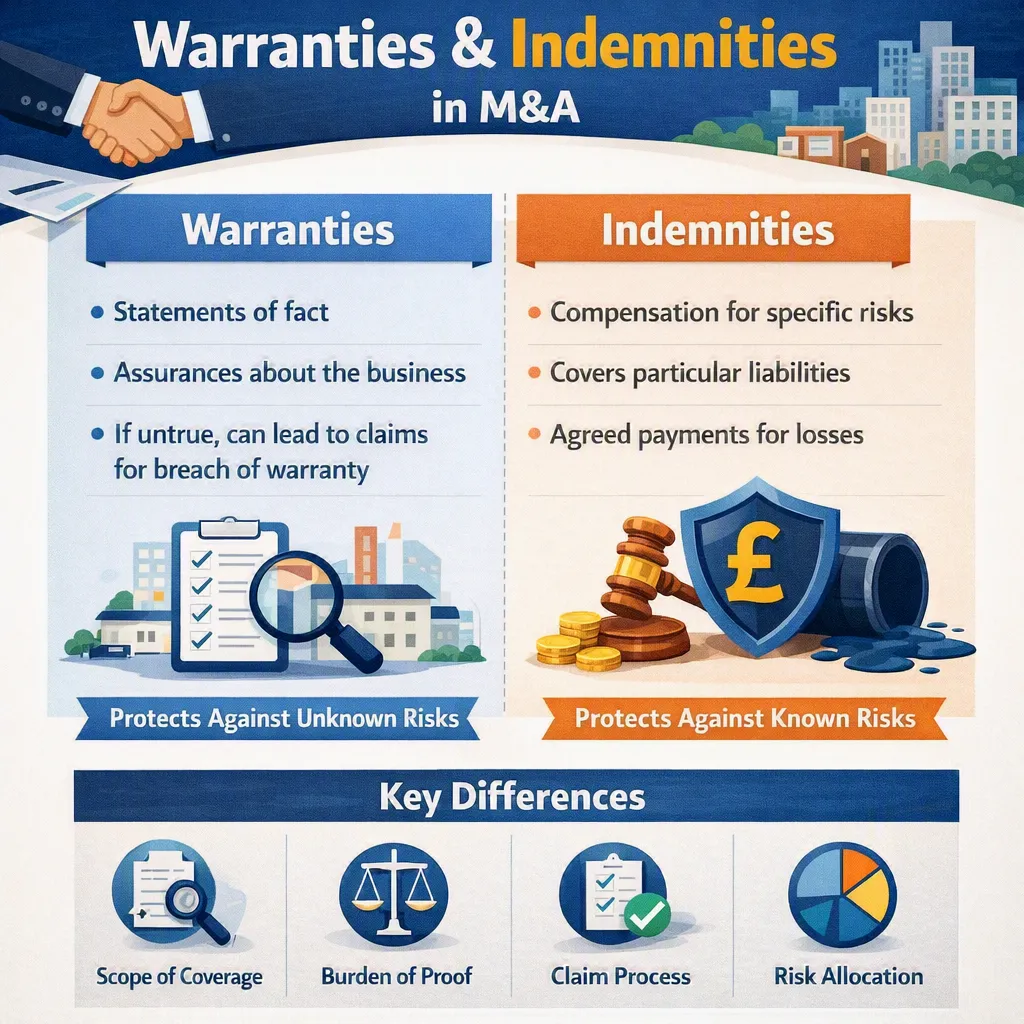
A warranty is a contractual statement of fact made by the seller to the buyer at the point of completion. The seller is stating that, to the best of their knowledge and belief, certain things about the business are true. If any of those statements later prove to be false — if the facts on the ground at completion were materially different from what the seller warranted — the buyer has a claim against the seller for the loss they have suffered as a result.
Warranties typically cover the full range of material facts about a business: the accuracy of the financial information, the completeness of the disclosed information, the absence of undisclosed liabilities, the good standing of customer and supplier contracts, the ownership of intellectual property, the employment arrangements of the workforce, the compliance status of the business, and the absence of ongoing or threatened litigation.
What warranties are not: they are not an insurance policy, and they do not automatically compensate the buyer for everything that goes wrong post-completion. To bring a warranty claim, the buyer must establish three things. First, that the seller made a specific warranty. Second, that the warranty was false at the date of completion. Third, that the buyer suffered a financial loss as a direct result of the warranty being false. All three must be present for a claim to succeed.
This creates an important practical limitation: a buyer who simply has a worse business than they expected cannot bring a warranty claim. The business underperforming against the model is not a warranty breach unless the underperformance is directly caused by a specific statement of fact that was false at completion. That distinction matters enormously in how post-completion disputes are assessed.
What Indemnities Are (And How They Differ From Warranties)
An indemnity is a contractual promise by the seller to pay the buyer pound for pound for a specific identified loss — without the buyer needing to prove that a warranty was breached or that they suffered a loss in the technical sense. The seller agrees: if X happens, I will pay you the amount of the cost.
Indemnities are used when a specific risk has been identified during due diligence — a tax liability that might crystallise, a regulatory matter that might result in a penalty, a known environmental issue that might require remediation — and the parties want to allocate that specific risk cleanly to the seller rather than leaving it in the general warranty framework.
The key difference: warranties require the buyer to prove causation and loss. Indemnities do not. If an indemnified event occurs, the seller pays the agreed amount, regardless of whether the buyer can technically demonstrate they have been damaged. This makes indemnities a more powerful protection for the buyer and a more onerous commitment for the seller. The seller's negotiating objective is therefore generally to avoid granting indemnities and to deal with identified risks through the warranty and disclosure process instead.
The Disclosure Letter: The Seller's Most Important Document
The disclosure letter is the document that qualifies the warranties — it is the seller's opportunity to state, formally and in writing, all the facts that would otherwise constitute a breach of the warranties they are giving. If the seller discloses a matter in the disclosure letter, the buyer cannot bring a warranty claim for loss arising from that matter, because the buyer knew about it at the point of purchase and chose to proceed.
This is why our post on what sellers do in due diligence that kills deals emphasises the importance of early, proactive disclosure. Whatever issues exist in the business — the customer dispute that was settled, the HMRC enquiry that was resolved, the lease assignment clause that creates a complication — they should be in the disclosure letter, with clear supporting documentation. Sellers who treat the disclosure letter as a liability to be minimised are taking entirely the wrong approach.
A well-prepared disclosure letter does three things simultaneously. It protects the seller legally by qualifying the warranties they have given. It builds buyer confidence by demonstrating transparency. And it provides a clear record of what was known and disclosed at completion — which resolves a significant proportion of the ambiguity that would otherwise generate post-completion disputes.
The disclosure letter is typically prepared by the seller's solicitor against each warranty in the SPA, working through the list systematically and identifying any facts that need to be disclosed. It should be comprehensive, specific, and supported by documentary evidence in a disclosure bundle. General disclosures — broad statements that the buyer should be deemed to know everything that could be discovered from a reasonable review of public information — are heavily contested by buyers' solicitors and provide limited protection to sellers in practice.
The Key Warranty Negotiations: What Buyers and Sellers Fight About
The Knowledge Qualifier
Most warranties are given subject to a knowledge qualifier — the seller warrants something to be true 'so far as the seller is aware' or 'to the best of the seller's knowledge and belief'. The buyer wants this qualifier to be as narrow as possible — ideally referring to the actual knowledge of specific named individuals. The seller wants it to be as broad as possible — referring only to conscious awareness, without any obligation to make enquiries.
The buyer's concern: a seller who claims not to know about a problem that they should have known about, or that their advisers or management team knew about, should not be able to hide behind a wide knowledge qualifier. The buyer's solicitor will push for the knowledge of key management as well as the seller to be included, and for the qualifier to include matters that the seller would have discovered on reasonable enquiry.
The seller's concern: being held to warranties about matters that are genuinely outside their knowledge — things that exist in the business's history or operations that they have never been aware of — creates an unlimited and unknowable liability. The seller's solicitor will resist any knowledge qualifier that requires them to warrant facts they cannot reasonably be expected to know.
The market standard in UK SME transactions is a knowledge qualifier that covers the actual awareness of the selling individuals plus the matters they would have discovered on making reasonable enquiries of the key management team. This is a reasonable middle ground that most experienced advisers on both sides will accept.
The Limitation Period
Warranty claims must be brought within a defined period after completion — the limitation period. UK statute law provides a six-year period for contract claims, but SPA warranty clauses almost always specify a shorter period. The market standard in UK SME transactions is:
General commercial warranties: 18 to 24 months from completion
Tax warranties and tax covenants: aligned to HMRC's enquiry window, typically 7 years
Title warranties (that the seller actually owns the shares): often unlimited or the statutory period
Sellers push for shorter limitation periods — 12 months is sometimes proposed for general warranties at the lower end of the market. Buyers push for longer periods, arguing that some warranty breaches only become apparent after the business has been owned for a full trading cycle.
The practical implication for buyers: a 12-month limitation period is genuinely restrictive. Many of the warranty breaches that matter most — undisclosed tax liabilities, hidden contractual obligations, employment matters — may not surface until more than 12 months post-completion. If a short limitation period is proposed, the buyer should seek to offset the reduced protection with more thorough pre-completion due diligence or warranty and indemnity insurance.
The financial caps
Warranty liability is almost always subject to two financial caps. First, an aggregate cap on total warranty claims — typically set at the purchase price for general warranties, but often reduced significantly in negotiations. Second, a de minimis threshold — a minimum claim value below which claims cannot be brought. The seller's solicitor will push for both a low aggregate cap and a high de minimis. The buyer's solicitor will push in the opposite direction.
The aggregate cap in UK SME transactions typically settles between 25% and 100% of the purchase price for general warranties, with a separate, higher (sometimes unlimited) cap for fundamental warranties relating to title and capacity. A 25% cap means that if the business has serious undisclosed problems, the buyer's maximum recovery from the seller is only a quarter of what they paid.
The de minimis threshold prevents the parties from spending disproportionate legal costs on minor claims. A threshold of 0.5% to 1% of the purchase price is typically accepted by both sides as reasonable. Claims that do not individually reach the de minimis cannot be brought, and claims cannot be accumulated until they reach an aggregate basket — typically 0.5% to 1% of the purchase price — before the buyer can bring any claim at all.
Tax Warranties and The Tax Deed
Tax matters in a share purchase are addressed both through general tax warranties in the SPA and through a separate tax deed — a covenant by the seller to indemnify the buyer for any tax liability attributable to a period before completion that was not reflected in the completion accounts. Tax is treated separately because the potential liability is both significant and long-tailed — HMRC can open enquiries into periods up to 20 years before completion in cases of fraud, and up to 6 years for general errors.
The tax deed is one of the most technically complex elements of any SPA negotiation and requires specialist input from both parties' tax advisers. The key points for buyers: ensure the tax deed covers all taxes for all periods up to completion, has a limitation period aligned to HMRC's enquiry windows, and contains specific provisions for management of any post-completion tax enquiry rather than leaving this undefined.
Warranty and Indemnity Insurance: When It Changes the Dynamics
Warranty and indemnity (W&I) insurance is a product that allows the buyer to claim against an insurer rather than against the seller for losses arising from warranty breaches. It has become significantly more accessible in the UK SME market in the last five years and has changed the warranty negotiation dynamic for deals above approximately £2m in value.
From the seller's perspective, W&I insurance is attractive because it removes or significantly reduces the ongoing financial exposure from warranties after completion — the seller receives a clean exit rather than a contingent liability that sits on their personal balance sheet for two years. From the buyer's perspective, it is attractive because the insurer has deeper pockets than most individual sellers and a more predictable claims process.
The practical mechanics: the policy is typically taken out by the buyer, underwritten against the representations and warranties in the SPA, and priced as a percentage of the insured limit — typically 1% to 2% of the policy limit. The cost is either borne by the buyer, split between buyer and seller, or incorporated into the overall deal economics.
W&I insurance does not replace thorough due diligence — insurers will not cover risks that were known about at the time the policy was issued, and a poorly conducted due diligence process typically results in a policy that is significantly excluded from the areas where losses are most likely. It is a risk transfer tool for genuinely unknown problems, not a substitute for finding them.
The Warranty Negotiation in Practice: Buyer & Seller Priorities
For buyers, the warranty negotiation priorities are: the widest possible scope of warranties covering all material aspects of the business, the narrowest possible knowledge qualifiers, an adequate limitation period, a meaningful aggregate cap, and specific indemnities for any risks identified in due diligence that deserve individual treatment.
For sellers, the priorities are: a disclosure letter that comprehensively qualifies all known issues, the shortest reasonable limitation period, the lowest aggregate cap that the buyer will accept, a high de minimis threshold, and the avoidance of specific indemnities where the warranty and disclosure process is adequate.
The negotiation is conducted primarily through the lawyers, but the principals need to understand the key battlegrounds well enough to provide clear instructions. Sellers who leave the warranty negotiation entirely to their solicitors sometimes find that provisions have been agreed that create significantly more ongoing exposure than they expected. Buyers who do the same sometimes find that the protection they were relying on has been negotiated away in ways that were not clearly communicated.
Read the warranty schedule and the limitation provisions yourself. Ask your solicitor to explain in plain commercial language what each significant concession means for your actual exposure. This is not a document to sign without understanding — it is the legal framework that governs your financial relationship with the other party for the next two to seven years.
What Good Warranty Protection Looks Like
A well-negotiated warranty package for a UK SME acquisition gives the buyer genuine recourse for material undisclosed problems, without creating an unlimited and open-ended exposure that makes the seller's net position from the sale uncertain. The specific parameters that define 'well-negotiated' vary by deal size, complexity, and the specific risk profile of the business — but the principles are consistent.
The seller's disclosure is complete, specific, and documented. The warranties are comprehensive but qualified by knowledge in a way that reflects what the seller can reasonably be expected to know. The limitation period is adequate for the types of problems that are most likely to emerge in this specific business. The aggregate cap provides meaningful but proportionate recourse. The tax deed covers all periods and all taxes. And any specific risks identified in due diligence are addressed through targeted indemnities rather than left in the general warranty framework.
That outcome is achievable in most well-advised transactions. It requires both parties to approach the negotiation with a genuine understanding of what they are agreeing to — and why.
Download the Deal Structure Cheat Sheet at www.DealwiseAdvisory.co.uk
Contact Steve at [email protected] to discuss the deal structure on a specific transaction
WhatsApp Steve on +44 7930-857243