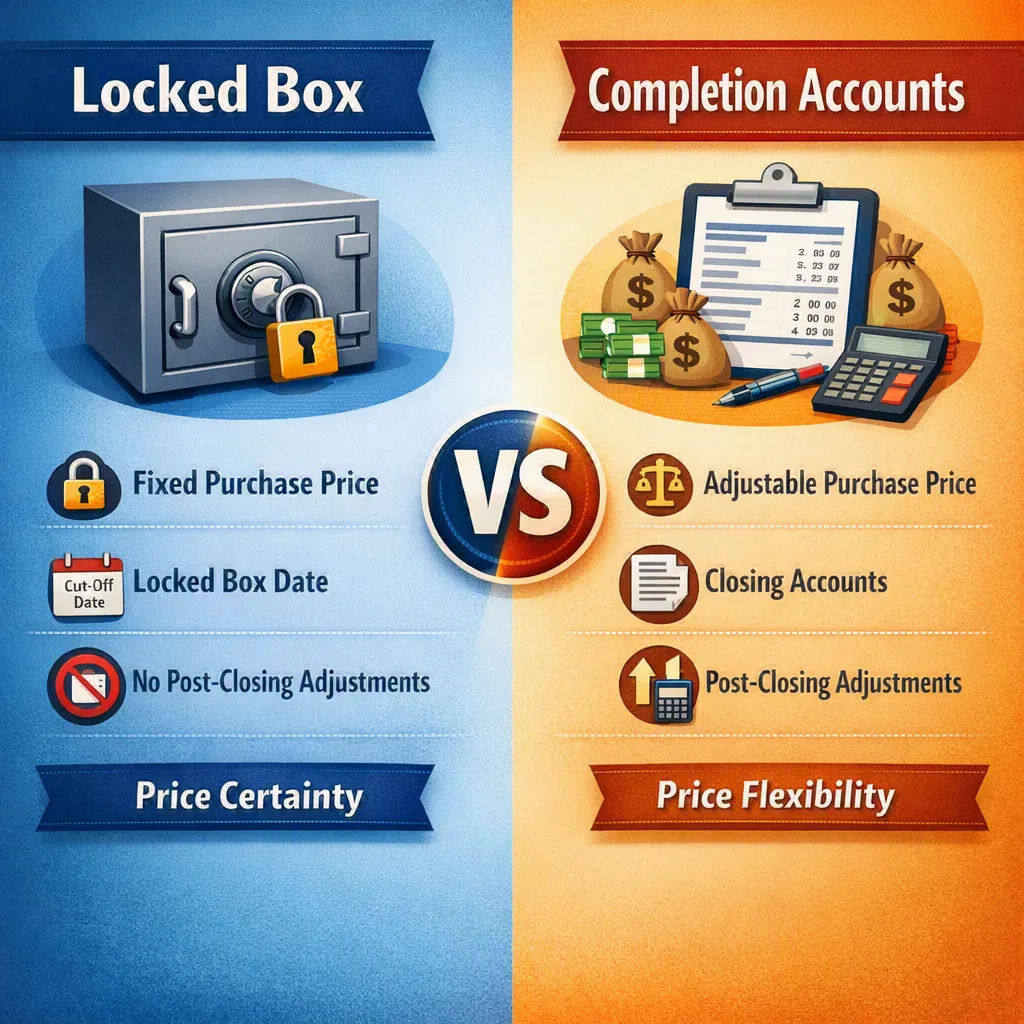
Locked Box Versus Completion Accounts: Understanding the Two Price Adjustment Mechanisms in UK Business Acquisitions
When a business is sold, there is almost always a gap between the date the price is agreed and the date the business is actually transferred. That gap — which might be four to twelve weeks in a standard UK SME transaction — is a period during which the business's financial position continues to change. Cash is generated and spent. Working capital moves. Liabilities are incurred and paid. By the time the buyer takes ownership, the financial position of the business is materially different from what it was when the price was negotiated.
The two main mechanisms for managing this mismatch — for ensuring the buyer pays a price that reflects the financial position of the business at the moment they actually own it, not the moment the price was agreed — are the locked box and the completion accounts. They are structurally different approaches to the same problem, they carry different risks for buyer and seller, and choosing between them (or understanding which one is being proposed) is a material commercial decision that belongs in the heads of terms conversation, not in the SPA negotiation.
This post explains how each mechanism works, what the risks are in each approach, and how to negotiate the specific terms that determine which party carries the most risk in each structure.
Why a Price Adjustment Mechanism Is Needed
Consider a simple example. A business is valued at five times its normalised EBITDA of £400k — a headline price of £2m. The price is agreed and heads of terms are signed on 1 March. Completion is planned for 30 April. During those eight weeks, the business generates £40k of profit that sits as cash on the balance sheet at completion. The seller has effectively retained value in the business — cash that was not there when the price was agreed — and under a simple share purchase with no adjustment mechanism, the buyer pays £2m and acquires a business with £40k more cash than was in it when the price was agreed.
The reverse is also possible. Between signing and completion, the seller pays themselves an unusually large dividend, draws down a cash balance, or allows the working capital position to deteriorate. Without an adjustment mechanism, the buyer pays £2m for a business that is worth materially less than it was when the price was agreed.
Both locked box and completion accounts are designed to prevent these outcomes — but they do so in fundamentally different ways, allocating the risk of value movement between signing and completion to different parties.
The Completion Accounts Mechanism
How it works
Under a completion accounts mechanism, the parties agree a price based on an estimated financial position at completion. The actual financial position is then calculated after completion — typically within 30 to 60 working days — from a set of accounts specifically prepared as at the completion date. The difference between the estimated position and the actual position produces a price adjustment: if the business has more value than estimated, the buyer pays more; if it has less, the buyer pays less.
The completion accounts typically focus on two key measures: net debt (cash minus borrowings at completion) and net working capital (debtors plus stock minus creditors at completion). The buyer is effectively paying a price based on a target level of both — the enterprise value, minus any net debt, adjusted for the difference between actual working capital and the agreed working capital peg.
The mechanics in practice
At completion, the buyer pays the estimated consideration — the agreed enterprise value adjusted for the estimated net debt and working capital position. Within the defined post-completion window, the seller (or sometimes jointly) prepares the completion accounts. The buyer has a period to review and challenge them. If the parties agree, the adjustment is made. If they do not agree, the dispute resolution mechanism — typically an independent accountant — determines the correct figures.
The completion accounts process is familiar to most M&A solicitors and accountants. It is also, as our Week 3 Deal Autopsy illustrated in detail, one of the most common sources of post-completion disputes when the definitions and mechanics are not precisely specified in the SPA. The working capital target, the accounting policies to be applied in preparing the completion accounts, the items included and excluded from each measure — all of these need to be agreed before completion, not left to interpretation afterwards.
Who carries the risk
Under a completion accounts structure, the buyer carries the risk of value movement between signing and completion — because the actual price they pay is not determined until the completion accounts are produced. If the business performs better than expected in the signing-to-completion period, the buyer pays more. The seller carries the risk of the accounting dispute: if the completion accounts are challenged successfully by the buyer, the seller receives less than they expected.
Sellers generally dislike completion accounts because of the uncertainty about the final price and the cost and complexity of the post-completion process. In the current UK SME market, sellers increasingly push for the locked box alternative precisely because it gives them certainty about what they will receive.
Negotiating the completion accounts terms
If completion accounts are being used, these are the specific terms that matter most to the buyer:
The definition of net working capital — which line items are included, how stock is valued, whether accrued income is included, whether inter-company balances are excluded. This definition must be agreed in the SPA, not left to the completion accounts preparer's judgement.
The accounting policies to be applied — specifically, that the completion accounts must be prepared using the same accounting policies that were applied in the business's historical accounts, not new policies that might produce a different result.
The timeline for preparation and review — how long the seller has to prepare the completion accounts, how long the buyer has to review and challenge them, and the specific escalation process if agreement cannot be reached.
The nominated independent expert — the firm and ideally the specific partner who will act as independent accountant if a dispute arises, agreed at the time of the SPA rather than after a dispute has developed.
The target working capital level — the agreed peg against which the actual completion working capital will be measured, set at the normalised mid-cycle position rather than a favourable point in the cycle.
The Locked Box Mechanism
How it works
Under a locked box mechanism, the parties agree a price based on the actual financial position of the business at a specific historical date — the locked box date, typically the most recent set of audited or reviewed accounts. From that date until completion, the 'box is locked' — the seller agrees not to extract any value from the business (through dividends, management charges, related party payments, or asset disposals) beyond what is explicitly permitted.
The buyer pays the agreed price at completion, with no post-completion adjustment for changes in the financial position of the business between the locked box date and completion. Instead, the risk of the business's financial performance during that period is carried by the buyer — who receives the economic benefit of any profits generated in the interim period alongside any deterioration in performance.
In exchange for carrying this risk, the buyer typically receives a daily interest accrual — called equity value accretion or ticker — which compensates them for the time value of money from the locked box date to completion. This accrual is added to the seller's consideration at completion, compensating them for the value generated in the business between the locked box date and the deal completing.
The permitted leakage concept
The locked box mechanism requires a precise definition of what value the seller is and is not permitted to extract from the business between the locked box date and completion. The items the seller is permitted to extract — typically salary, dividends within agreed parameters, and defined management charges — are called permitted leakage. Everything else is non-permitted leakage.
Non-permitted leakage is a warranty breach that entitles the buyer to a pound-for-pound reduction in the consideration. The seller warrants that no non-permitted leakage has occurred, and the buyer's remedy if it has is a direct claim against the seller for the amount of the leakage.
The definition of permitted and non-permitted leakage is one of the most important elements of a locked box SPA. A buyer who does not scrutinise this definition carefully may find that the seller has structured permitted leakage broadly enough to allow significant value extraction during the locked box period — extraction that was not contemplated in the price but which is technically within the permitted leakage basket.
Who carries the risk
Under a locked box, the seller has certainty — they know exactly what they will receive at completion, subject only to the leakage protections. The buyer carries the risk of the business's financial performance between the locked box date and completion: if the business has a bad period in the interim, the buyer pays the same price regardless.
This is why sellers prefer the locked box and buyers historically preferred completion accounts. The locked box transfers execution risk to the buyer. The completion accounts allow the buyer to share in the actual financial position at completion, which means they do not pay for profits the business has not yet generated, but they do pay more if the business performs well.
When the locked box is the right choice for a buyer
Despite the conventional wisdom that buyers prefer completion accounts, there are situations where a locked box is genuinely the better choice for the buyer. If the locked box date is recent — within the last three to four months — the period of business risk the buyer is carrying is short. If the business is highly predictable — stable contracted revenues, manageable costs, no seasonal peaks in the interim period — the risk of material deterioration is low. And if the buyer wants to avoid the cost, complexity, and dispute risk of the completion accounts process, the locked box provides a cleaner and faster path to completion.
In the current UK SME market, where many sellers have become familiar with the locked box as a seller-friendly mechanism, buyers who accept it gracefully — rather than insisting on completion accounts — sometimes find that the goodwill generated in the negotiation produces other concessions that more than offset the theoretical risk they have accepted.
The Specific Risks in Each Mechanism — Side by Side
For buyers, the completion accounts mechanism carries the following specific risks: the accounting dispute risk — that the completion accounts are prepared in a way that favours the seller, leading to a dispute that consumes time and money; the working capital peg risk — that the peg was set at the wrong level, producing an adjustment that was not anticipated; and the timeline risk — that the post-completion process extends the period of uncertainty about the final price.
For buyers, the locked box mechanism carries the following specific risks: the locked box period performance risk — that the business underperforms between the locked box date and completion, and the buyer pays full price for a business whose financial position has deteriorated; the leakage definition risk — that permitted leakage was defined broadly enough to allow value extraction the buyer did not anticipate; and the historical accounts risk — that the locked box date accounts do not accurately reflect the business's financial position, producing a price that was never correct.
Sellers face the inverse risks in each mechanism. The key point for both parties: neither mechanism is inherently superior. The right choice depends on the specific transaction, the quality of the locked box accounts, the predictability of the business's performance in the interim period, and the relative negotiating positions of buyer and seller. Understanding both mechanisms clearly, and negotiating the specific terms that mitigate the risks in whichever approach is chosen, is the important thing.
The Practical Recommendation
For most UK SME transactions in the £500k to £5m enterprise value range, the locked box mechanism — based on recent reviewed or audited accounts — is increasingly the market standard and is generally acceptable to well-advised buyers when the locked box date is recent, the accounts are reliable, and the permitted leakage definition is tight.
The completion accounts mechanism remains appropriate where the business has material seasonality that makes the locked box date accounts unrepresentative, where the interim period is long and the buyer's exposure to performance risk is significant, or where the buyer has reason to believe the historical accounts are less reliable than the seller represents.
In either case, the mechanics should be agreed in heads of terms — not left to the SPA negotiation. A price adjustment mechanism that is agreed in principle but not specified in detail is a dispute waiting to happen. The time to get it right is before the lawyers start drafting.
Download the Deal Structure Cheat Sheet at www.DealwiseAdvisory.co.uk
Contact Steve at [email protected] to discuss the completion mechanics on a specific deal
WhatsApp Steve on +44 7930-857243