The UK SME M&A Market in 2025: What Is Actually Happening to Multiples, Deal Volumes, and Deal Structures
The most useful market commentary is not the one that tells you what happened last quarter. It is the one that tells you what the conditions you are operating in right now actually mean for the decisions you need to make. This post is an attempt at that — a frank assessment of where the UK SME M&A market sits in 2025, based on what is actually happening in transactions rather than what the headline indicators suggest.
The context matters because the market in 2025 is genuinely different from the market in 2021 and 2022, and different again from the correction period of 2023 and early 2024. Understanding those differences — in valuation multiples, in deal structures, in buyer profiles, in the gap between seller expectations and buyer appetite — is directly relevant to anyone buying or selling a business right now, and to anyone planning to do so in the next twelve to eighteen months.
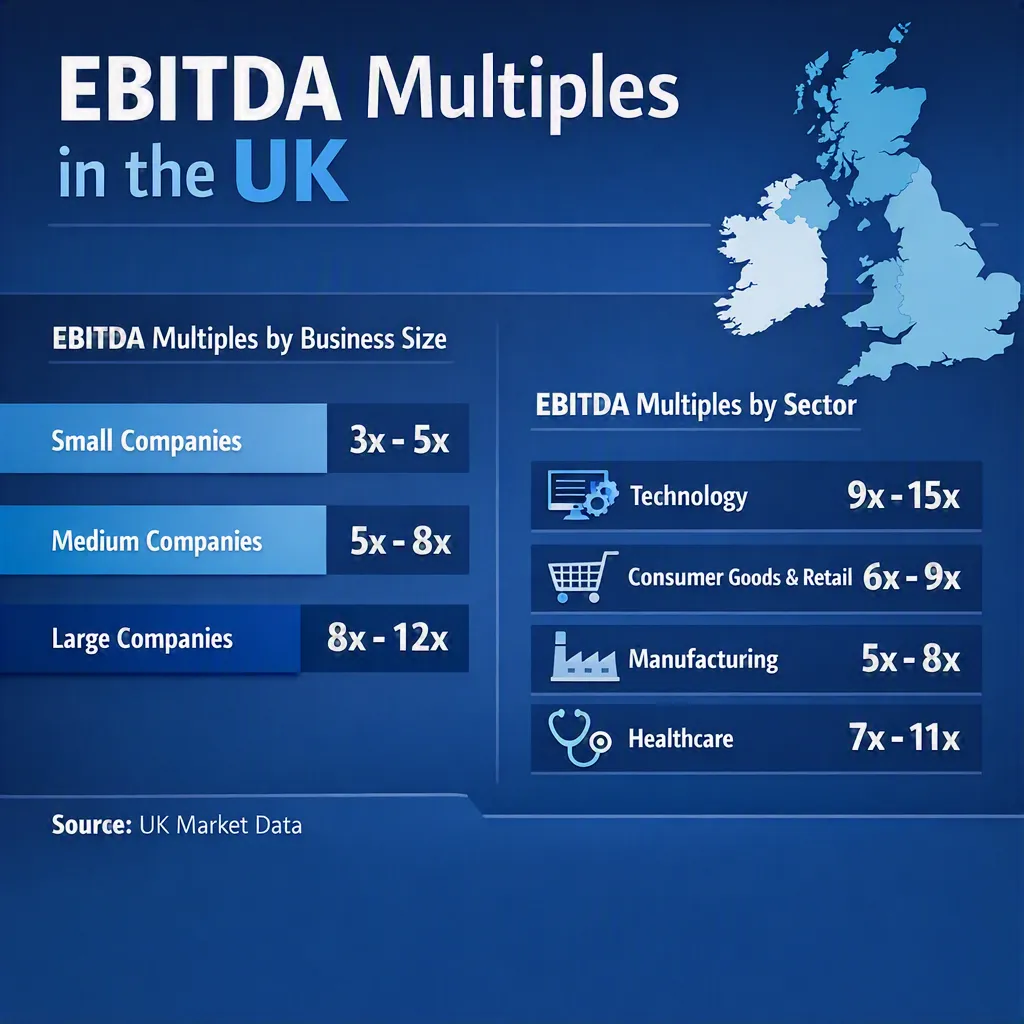
Where Multiples Actually Sit in 2025
The multiple correction that began in late 2022 — driven by rising interest rates, constrained acquisition debt availability, and the withdrawal of the private equity capital that had pushed SME multiples to historic highs in the preceding two years — has largely worked through the market. The froth is gone. The base has restabilised. And the multiples available for well-prepared, well-run businesses in attractive sectors are, by historical standards, entirely reasonable.
What that looks like in practice, across the main SME sectors:
Technology and software
Genuine SaaS businesses with strong recurring revenue, high retention rates, and real product differentiation continue to attract the highest multiples in the SME market — typically 6x to 9x EBITDA, with outliers above that for businesses with exceptional characteristics. The compression from 2021 peak levels (where 10x to 15x EBITDA was achievable for quality software businesses) is real but has largely stabilised. Buyers in this sector have recalibrated their return models to the current financing environment and deals are completing.
The important qualification: the technology sector is highly stratified. True SaaS businesses attract premium multiples. Technology-enabled service businesses — those that use technology extensively but deliver services at a cost that scales with headcount — are valued much more like professional services businesses than like software businesses. The distinction between recurring software revenue and high-utilisation professional service revenue is the most important valuation judgement in the technology sector and one that buyers and sellers often see very differently.
Professional services
Accountancy, legal, financial advisory, HR, compliance, and specialist consulting businesses — where a meaningful proportion of revenue is under retainer or long-term contracts — are transacting at 4x to 5.5x EBITDA for well-prepared businesses. The upper end of that range is reserved for businesses with genuine management team depth, diversified client bases, and documented recurring income. The lower end reflects businesses where owner dependency is high and the revenue quality is more relationship-dependent than contractual.
The professional services sector has seen significant acquisition activity in 2025 from consolidation-focused buyers — acquirers building scale platforms in accountancy, HR advisory, and specialist legal services. Those buyers are paying full multiples for quality businesses because they have a clear strategic rationale for the acquisition. Sellers in this sector who have prepared their businesses properly are finding a receptive buyer market.
Healthcare and life sciences services
Healthcare services businesses with CQC registration, NHS framework agreements, or established private clinical revenue streams continue to attract strong multiples — 5x to 8x for well-positioned businesses. The structural demand drivers are favourable: NHS outsourcing, ageing population dynamics, and the growing private healthcare market all support sustained buyer interest. Multiples at the upper end require management team depth, regulatory compliance strength, and genuinely diversified revenue across commissioners.
Manufacturing and engineering
Specialist manufacturers with proprietary products, established customer relationships, and genuine technical differentiation are transacting at 4x to 5.5x EBITDA. Commodity manufacturers and contract manufacturers without differentiation continue to attract more modest multiples — 2.5x to 3.5x — reflecting the higher capital intensity and lower pricing power of those business models. The manufacturing sector has been affected by input cost pressures and supply chain uncertainty in recent years, and buyers are asking hard questions about margin sustainability before committing to full multiples.
Trade services and construction
Specialist trade businesses with recurring maintenance or service contract income are attracting 3.5x to 5x EBITDA. General contractors and project-dependent trade businesses remain at 2.5x to 3.5x, reflecting the project risk and working capital volatility of those models. The demographic tailwind in this sector — retiring business owners without succession — continues to create genuine acquisition opportunities for prepared buyers willing to take on the key person dependency work in the first year of ownership.
What Has Happened to Deal Structures in 2025
The shift in deal structures that began in the 2022 to 2024 period has continued and in some respects deepened. The most significant structural changes:
Vendor finance is no longer the exception
In 2019 and 2020, vendor finance was used in perhaps 20% to 30% of UK SME transactions in the sub-£5m enterprise value range. In 2025, it is present in the majority of SME deals we are seeing at this level — not necessarily as the primary funding source, but as a component of the capital structure that bridges the gap between what senior debt can provide and the total consideration required.
The normalisation of vendor finance reflects two concurrent developments. First, sellers have come to understand that vendor finance is not a sign of buyer weakness — it is a standard component of the modern SME deal structure. Second, buyers have become more sophisticated in presenting vendor finance as a tool that aligns interests and signals seller confidence, rather than as a request for a favour.
The terms of vendor finance have also evolved. In 2020, the typical vendor loan was at 5% to 6% interest over three years. In 2025, terms of 7% to 9% over three to five years are increasingly common, reflecting the higher base rate environment and the longer repayment periods that larger vendor loan components require.
Earn-outs are more carefully documented — but still common
Post the cases we have seen (and written about in this blog) of earn-out disputes consuming years of legal fees and management attention, the documentation standards for earn-outs in UK SME transactions have improved. The EBITDA definition is more carefully specified. The operational covenants protecting the seller's earn-out are more commonly included. The dispute resolution mechanisms are faster and better defined.
But earn-outs remain common — particularly in professional services and technology acquisitions where the valuation gap between buyer and seller is most likely to reflect genuine uncertainty about whether recent performance is structural or transitional. The challenge for both parties is ensuring the earn-out is documented to the standard our Week 6 deal autopsy identified as essential, rather than to the standard of the deal described in that autopsy.
Completion timelines have shortened for quality businesses
One of the more surprising market developments in 2025 is the compression of completion timelines for well-prepared businesses with clean financial records and a complete data room. Buyers and their advisers have become more efficient at processing due diligence on businesses that present themselves clearly. Four to five months from first meeting to completion is increasingly achievable for clean, well-prepared SME transactions — significantly faster than the six to nine months that was common in 2020 and 2021.
The inverse is also true: poorly prepared businesses — those with incomplete financial records, incomplete data rooms, and unexplained gaps in the disclosure — are taking longer to close than ever, as buyers spend more time seeking information rather than assessing it. The preparation premium in terms of completion speed is now significant and is beginning to be understood by sellers who have seen deals drag because of documentation issues that were avoidable.
The Buyer Market in 2025 — Who Is Actually Buying
The buyer landscape for UK SME businesses has shifted materially since 2022. The profile of the most active buyers in the sub-£10m enterprise value segment:
Owner-operators and acquisition entrepreneurs
Individual acquisition entrepreneurs — people buying their first or second business using a combination of personal equity, senior debt, and vendor finance — remain the most numerically active buyer group in the UK SME market. The community of acquisition entrepreneurs has grown significantly over the past four years, driven in part by the educational content and community infrastructure that has developed around the acquisition entrepreneur model.
This buyer group is more commercially sophisticated than it was five years ago — better educated about deal mechanics, more familiar with creative structures, and more disciplined about due diligence — which is broadly positive for the quality of deals that complete. The challenge is that the most popular sectors for first-time buyers (business services, professional services, trade services) are also the most competitive, and the best businesses in those sectors are being priced accordingly.
Search funds
The search fund model — where an individual raises capital from investors to fund their full-time search for an acquisition, then completes an acquisition with investor backing — has grown significantly in the UK over the past five years. There are now several dozen active UK search funds at any given time, representing a meaningfully funded and professionally structured buyer group for businesses in the £2m to £15m enterprise value range.
Search fund buyers are well-capitalised, professionally advised, and typically patient — they are searching full-time and have investor capital committed to completing a transaction. For sellers in the right size and sector range, a search fund buyer can represent an excellent outcome: a committed, well-resourced buyer who intends to operate the business for five to seven years before a further exit.
Platform acquirers and consolidators
Private equity-backed consolidators and owner-operated platform businesses remain active in the UK SME market, particularly in fragmented sectors where roll-up strategies produce genuine multiple arbitrage. Healthcare, accountancy, building services, and specialist professional services are the most active consolidation sectors in 2025. Platform acquirers in these sectors are strategic buyers who typically pay full or above-market multiples for quality businesses that fit their roll-up thesis.
The challenge for sellers: platform acquirers can move quickly and pay well, but they also have clear integration plans that may not align with what the selling owner wants for the business's future. Understanding the specific acquirer's consolidation strategy — and what happens to the business, the people, and the brand post-completion — is important context for any seller evaluating a platform offer.
What Sellers Should Expect in the Current Market
The honest assessment for a business owner considering a sale in the second half of 2025:
Multiples for well-prepared businesses in attractive sectors are achievable and competitive — the market is functional, deal activity is solid, and genuine quality attracts genuine interest
Multiples for underprepared businesses, or businesses with the structural characteristics that suppress multiples — owner dependency, customer concentration, poor financial records — are significantly below where they were in 2021 and 2022, and buyers are less willing to look past those issues in the hope of an off-market premium
Deal structures will include deferred consideration, vendor finance, or earn-out elements for the majority of transactions — full cash on completion at a full multiple is reserved for the strongest businesses in the most competitive processes
Competition for quality businesses remains real — a well-prepared business going to market with a professional process and a realistic price will attract multiple serious buyers
The preparation premium has never been higher — the gap in achievable multiple between a well-prepared and a poorly prepared business of otherwise similar quality is wider in the current market than at any point in the past five years
What Buyers Should Expect in the Current Market
For buyers looking at the second half of 2025:
Deal flow from motivated sellers is strong — the demographic pipeline of retiring business owners without succession is now at its most concentrated, and the cohort of owners who delayed exit decisions in 2022 and 2023 is now actively considering sale
Competition for the best businesses is real — quality businesses with strong recurring revenue, clean financials, and genuine management depth attract multiple buyers and are priced accordingly
Creative deal structuring is a genuine competitive advantage — the buyer who can demonstrate flexibility on structure, who understands vendor finance and earn-out mechanics, and who can move decisively when a deal is right will consistently access better businesses than the buyer who can only offer a simple cash structure
The financing environment has stabilised — acquisition debt is available at predictable terms for well-structured transactions, and lenders are actively looking to deploy in the SME acquisition market
Due diligence standards have risen — the quality of financial records and disclosure that sellers and their advisers now produce has improved, but so has the sophistication of buyer due diligence; the days when a cursory review of three years of accounts was sufficient to complete are gone for serious buyers
The Market for the Next Twelve Months
The direction of the UK SME M&A market over the next twelve months is shaped by several converging forces. Interest rates, having peaked and begun to moderate, are expected to continue their gradual reduction — which eases the acquisition debt affordability constraint and, over time, supports modest multiple expansion for the highest-quality businesses. The demographic wave of retiring business owners will continue to generate motivated sellers across all sectors. And the acquisition entrepreneur community will continue to grow, increasing the depth of the buyer pool for businesses in the most popular acquisition sectors.
The most likely outcome is a market that continues to function well for well-prepared sellers and disciplined buyers — not the frenzied activity of 2021 and not the stalled conditions of late 2022 and 2023, but a steady, professionally managed deal environment where quality is rewarded and preparation matters.
For business owners thinking about exit, 2025 and 2026 represent a window that combines motivated buyer activity, stabilised multiples, and the demographic tailwind of succession-driven deal flow. The owners who go to market well-prepared in this window will achieve better outcomes than those who wait for the next market peak — which, in the absence of a return to the ultra-low interest rate environment that drove 2021 conditions, may be some years away.
Download the Dealwise Business Valuation Playbook for a detailed framework on how to assess your business's value in the current market — and what preparation work will most improve the multiple you achieve.
Download the Business Valuation Playbook at www.DealwiseAdvisory.co.uk
Contact Steve at [email protected] for a frank market valuation conversation about your business
WhatsApp Steve on +44 7930-857243