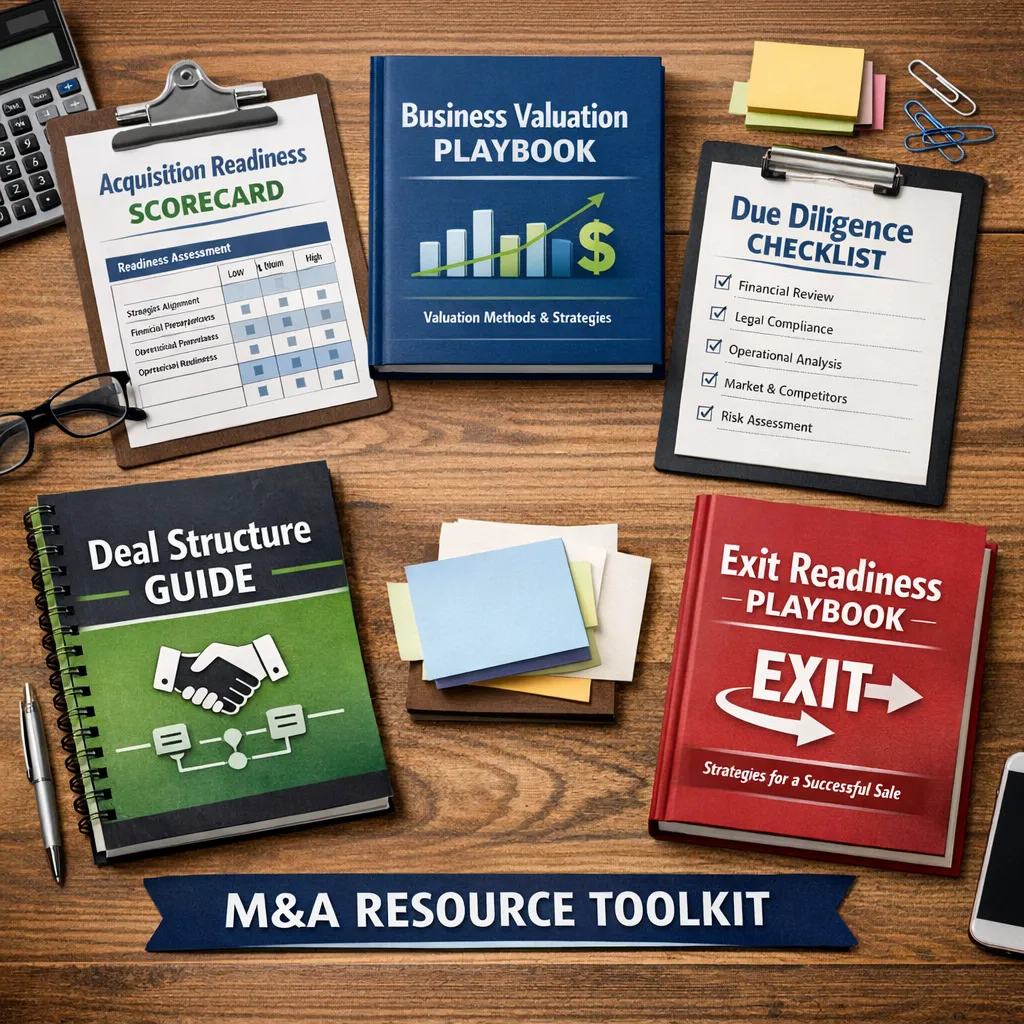
The Dealwise Toolkit: Every Free Resource to Help You Buy, Build and Sell a Business
One of the most consistent things I hear from people who are thinking about buying or selling a business is that they do not know where to start. They understand the broad concept. They know deals happen. But the specific knowledge — how businesses are actually valued, what due diligence really involves, how deals are structured, what to fix before you go to market — is either locked behind expensive advisory relationships or buried in technical material that was not written for them.
The Dealwise toolkit exists to change that. Every resource below is built around real deal experience — the frameworks I use, the checklists that surface the issues that matter, the guides that translate complex mechanics into plain commercial language. They are free. They are practical. And they are designed to give you a genuine head start, whether you are buying your first business, preparing for an exit, or trying to understand whether a specific opportunity is worth pursuing.
This post brings everything together in one place — what each resource covers, who it is for, and where to get it.
Resource 1: The Acquisition Readiness Scorecard
What it is
An interactive 12-question assessment that evaluates your readiness to buy a business across the dimensions that actually determine whether acquisitions succeed or fail. Financial literacy, valuation knowledge, deal structuring understanding, due diligence process, financing plan, sector knowledge, adviser team, post-acquisition plan, personal bandwidth, risk tolerance, emotional readiness, and support network.
Who it is for
Anyone who is thinking about buying a business — whether you are at the very start of the journey or actively looking at deals. It works equally well as a first step for someone who has never done a deal and as a gap analysis for someone who has done one or two and wants to understand where their weakest point is before they go again.
What you get
A personalised score across all twelve dimensions, a clear picture of where you are strong and where you have genuine gaps, and a prioritised set of recommendations for what to address first. The scorecard takes less than ten minutes to complete and the output is specific enough to be genuinely actionable — not a generic report that tells you to learn more about finance.
Why it matters
The deals that fall apart are rarely about the business. They are about the buyer. Buyers who are underprepared — who do not understand the financial mechanics, who have not tested their financing assumptions, who have no post-acquisition plan — create problems in the process and difficulties post-completion that could have been avoided. The scorecard tells you where you stand before those problems arise.
Where to get it
Take the Acquisition Readiness Scorecard by clicking here — or WhatsApp Steve on +44 7930-857243 and he will send you the link directly.
Resource 2: The Business Valuation Playbook
What it is
A 12-page PDF guide that explains how businesses are actually valued in the UK SME market — from a buyer's perspective. Covers the EBITDA multiple method in detail, the normalisation adjustments that are legitimate versus the ones that destroy trust, the five value drivers that move multiples, the difference between asset-based and earnings-based approaches, and the most common valuation mistakes made by both buyers and sellers.
Who it is for
Business owners who want to understand what their business is genuinely worth before they go to market. Acquisition entrepreneurs who want to understand how to assess and challenge seller valuations. Anyone who has received a valuation and is not sure whether to trust it.
What you get
A clear, jargon-free explanation of how valuation actually works in practice — written by someone who has sat on both sides of the table and knows the difference between theoretical valuation models and what buyers actually pay. The playbook includes worked examples, a normalisation adjustment framework, and a summary of the most common misconceptions that cost sellers money and mislead buyers.
Why it matters
Misaligned valuation expectations are the single most common reason deals fail to progress beyond the first conversation. A seller who understands how buyers think about value — and a buyer who can articulate a valuation rationale with confidence — both get better outcomes. This playbook closes that gap.
Where to get it
Download the Business Valuation Playbook by clicking here
Resource 3: The Due Diligence Red Flag Checklist
What it is
A 40-point checklist covering the financial, legal, commercial, and operational issues that matter most in UK SME acquisitions. Each item is accompanied by a brief explanation of why it matters and what a satisfactory answer looks like — so the checklist is educational as well as practical.
Who it is for
Buyers who are actively looking at deals and want a structured framework for due diligence — particularly first-time buyers who are not yet sure what they are looking for. Also useful for advisers who want a starting framework to adapt for specific transactions.
What you get
A ready-to-use due diligence framework organised across four workstreams: financial, legal, commercial, and operational. The checklist is designed to be used alongside professional advisers — not as a replacement for them — but it means you arrive at every due diligence conversation with a clear framework rather than relying entirely on your advisers to set the agenda.
Why it matters
The most expensive due diligence failures in acquisitions are not the result of buyers being deceived. They are the result of buyers not asking the right questions. The Red Flag Checklist is built from the specific questions that have surfaced the most material issues across real transactions — the working capital mechanics, the lease assignment clauses, the customer concentration risks, the related-party transactions — that first-time buyers most commonly miss.
Where to get it
Download the Due Diligence Red Flag Checklist free by clicking here or visit us at www.DealwiseAdvisory.co.uk
Resource 4: The Deal Structure Cheat Sheet
What it is
A 19-page reference guide covering the main deal structures used in UK SME acquisitions — cash on completion, deferred consideration, earn-outs, vendor finance, and asset-backed structures. For each one, the cheat sheet covers when to use it, the key terms to negotiate, the main risks for each party, and how structures are typically combined in practice.
Who it is for
Buyers who are approaching negotiation and want to think clearly about their structural options. Business owners who have received an offer and want to understand what the proposed structure actually means for them — particularly where earn-outs or deferred consideration are involved. Advisers who want a clean reference document to use in client conversations.
What you get
A single-page tool that you can use in deal conversations — either to think through your own position or to explain structural options to a seller who is less experienced with acquisition mechanics. Clear enough for a first-time buyer to understand. Specific enough to be useful in a real negotiation.
Why it matters
Buyers who understand deal structures have more tools available to them. They can make deals work that a buyer limited to cash-on-completion thinking cannot. They can bridge valuation gaps without simply paying more. They can reduce upfront capital requirements while still delivering outcomes that work commercially for the seller. The cheat sheet is the fastest way to get the main structures clear in your head before you enter a negotiation.
Where to get it
Download the Deal Structure Cheat Sheet free by clicking here or you can visit us at www.DealwiseAdvisory.co.uk
Resource 5: The Exit Readiness Traffic Light
What it is
A structured assessment that evaluates a business across six exit readiness dimensions — financial records and reporting quality, key person dependency, customer concentration and contract quality, legal and contractual housekeeping, management team strength, and the completeness of the business narrative. Each dimension is scored red, amber, or green, giving the business owner a clear visual picture of where they are genuinely ready and where preparation work is still needed.
Who it is for
Business owners who are thinking about selling in the next one to five years and want an honest, structured view of where their business stands. Also useful for owners who have no immediate intention to sell but want to run a more valuable, more transferable business — the exit readiness dimensions overlap almost entirely with the things that make a business excellent to own.
What you get
A traffic-light dashboard across the six dimensions, a prioritised list of the preparation actions with the highest impact on exit outcome, and an honest assessment of the likely timeline to get from the current position to genuine market readiness. The output is specific to the responses given — not a generic report with generic recommendations.
Why it matters
Most business owners who go to market unprepared do not know they are unprepared. They know there are things they could improve, but they have not mapped those improvements against what a buyer actually looks for and how each gap affects the price, the structure, and the likelihood of a deal completing. The Exit Readiness Traffic Light makes that mapping explicit — and gives the owner a clear plan for closing the gaps before they go to market.
Where to get it
Get the Exit Readiness Playbook by clicking here — or visit us at www.DealwiseAdvisory.co.uk.
Resource 6: The Dealwise Blog — Weeks of Practical Deal Content
The Dealwise blog is the content engine behind everything else in the toolkit. Every post is built around real deal experience — not theoretical frameworks, not generic business advice, but the specific mechanics, lessons, and patterns that emerge from actually doing transactions.
Across the first five weeks of content, the blog has covered:
The complete guide to buying a business in the UK — from deal sourcing to post-completion integration
How businesses are actually valued — the EBITDA multiple method, normalisation, and the five value drivers that move multiples
Due diligence in full — the four workstreams, the financial checklist, the red flags, and the working capital mechanics that catch first-time buyers most often
Deal structuring — share versus asset purchase, earn-outs, vendor finance, deferred consideration, and how structures are combined in practice
Preparing to sell — the six sale readiness dimensions and the timeline for preparation that produces the best exit outcomes
A full deal autopsy — the mechanics of a real working capital dispute, how it unfolded, how it was resolved, and five specific lessons for buyers and their advisers
Exit planning — the three planning horizons, the tax considerations that need to be addressed before the sale, and the internal exit routes available to UK business owners
Financial engineering — the capital stack, senior debt mechanics, asset-backed finance, holding company structures, and a worked example showing how a deal is funded with limited equity
The acquisition entrepreneur mindset — the specific thinking patterns that distinguish buyers who build successful acquisition careers from those who struggle
Every post in the blog cross-references the others — so as the content library grows, each piece becomes more valuable as part of the whole. Use the category navigation to find the content most relevant to where you are in the process.
Working With Dealwise Directly
The toolkit is designed to give you the knowledge and frameworks to approach acquisitions and exits with genuine commercial clarity. But knowledge and frameworks are the foundation, not the building. The decisions you make — which business to buy, at what price, with what structure, through what legal framework — are consequential and irreversible. The cost of getting them wrong is real.
Steve Rooms works with a select group of acquisition entrepreneurs and business owners at the point where the stakes are highest — structuring deals, reviewing financials, challenging assumptions, and making sure the decisions being made are grounded in commercial reality rather than optimism.
If you are looking at a specific deal and want a second opinion from someone who has been in the room — or if you are a business owner preparing for exit and want advisory support through the process — the conversation starts with a direct message or a call.
The resources are free. The expertise is not. But for the right situation, the advisory relationship pays for itself many times over in the outcome it produces.
Explore all Dealwise resources at www.DealwiseAdvisory.co.uk
Contact Steve directly at [email protected]
WhatsApp Steve on +44 7930-857243