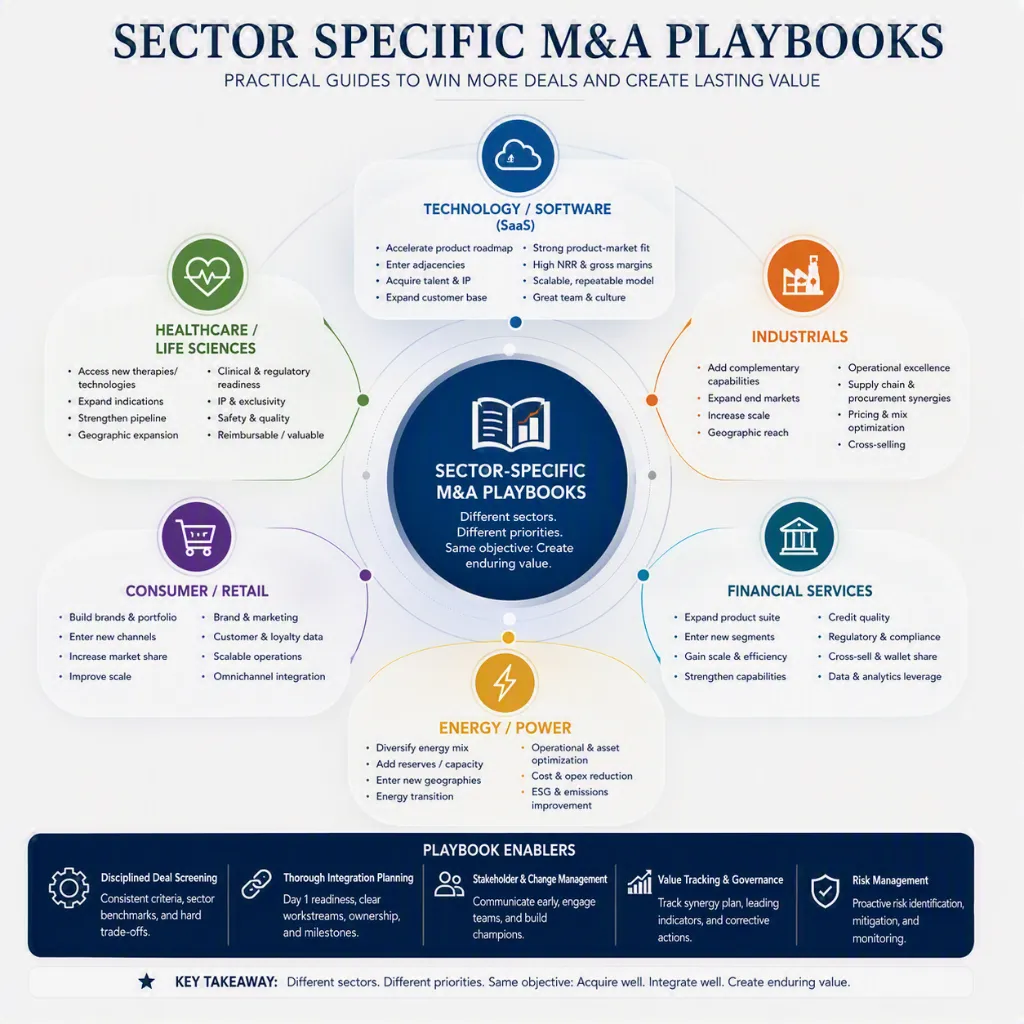
Sector-Specific Acquisition Playbooks: What to Investigate, What to Watch For, and What to Fix First in Professional Services, Trade Services, and Manufacturing
The general acquisition framework — due diligence process, deal structure, post-completion integration — applies across all business types. But the specific things that matter most, the red flags that are unique to particular business models, and the post-acquisition priorities that vary by sector are not covered in a general guide. A professional services acquisition and a manufacturing acquisition are both business purchases. They are not the same experience.
This post is a sector-specific supplement to the general acquisition content on this blog. It covers three of the most commonly acquired business types in the UK SME market — professional services, trade services, and manufacturing — with a specific playbook for each: what to investigate that the general framework does not emphasise, the specific red flags that appear most often in that sector's transactions, and the post-acquisition priorities that matter most in the first twelve months of ownership.
Professional Services: Accountancies, Consultancies, Advisory Firms
Professional services businesses — accountancy practices, HR consultancies, legal firms, marketing agencies, engineering consultancies, and specialist advisory businesses — are among the most commonly acquired SME businesses in the UK. Their appeal is real: low capital intensity, high gross margins, often sticky customer relationships, and businesses that can generate strong EBITDA from relatively simple operational models. Their specific acquisition challenges are equally real and consistently underestimated by first-time buyers.
What to investigate that the general framework does not emphasise
Fee earner productivity and utilisation. In any professional services business, the primary asset is the time of the fee-earning staff. Understanding how efficiently that time is being used — the utilisation rate (billable hours as a percentage of available hours), the realisation rate (fees actually billed as a percentage of hours recorded), and the average billing rate per fee earner — tells you whether the business's gross margin is genuinely sustainable or whether it is being subsidised by underpriced work or unpaid overtime.
Request a fee earner productivity report for the last twelve months. If the business does not produce one, ask for the data needed to build it yourself. A professional services business that cannot tell you its utilisation and realisation rates is a business whose profitability has never been properly understood — which means the EBITDA you are being asked to pay a multiple for may be less reliable than it appears.
Client tenure and billing concentration per fee earner. The client relationships in a professional services business are often distributed unevenly across the team. One or two fee earners may hold the majority of the billing relationships. Understanding the distribution — which clients are billed by which fee earners, and what the relationship tenure looks like — tells you the specific people risk that was explored in the Week 15 deal autopsy. If three fee earners hold 70% of the client billing and two of them are the partners or directors who are selling, the revenue transferability risk is significant.
Work in progress and billing cycle. Professional services businesses often have significant work in progress — completed or partially completed work that has not yet been invoiced. WIP is a balance sheet asset, but its realisability depends on whether the work has been properly completed and whether the client will accept the invoice without dispute. A large, ageing WIP balance — particularly in a business that invoices at completion rather than in stages — may represent revenue that will not be collected at the value shown.
Sector-specific red flags
A high-billing partner who is also the seller and whose client relationships are personal rather than institutional — this is the most common value risk in professional services acquisitions
Billing rates that have not increased in three or more years despite inflation — a sign of either weak client relationships, an inability to have pricing conversations, or an owner who has deliberately kept prices low to maintain relationships they know are personal
A workforce where the employment contracts do not include non-solicitation clauses — any fee earner who leaves can take their clients without legal consequence
Revenue recognition on completion rather than in stages for long projects — a large single invoice at project end means the P&L can look strong in a period when the cash has not yet been collected
A client that has been with the firm for many years and whose relationship is entirely with one fee earner who is approaching retirement
Post-acquisition priorities in professional services
The first priority is stabilising the client relationships that were identified in due diligence as potentially personal to the seller. This means direct introductions, proactive communication, and relationship-building meetings in the first thirty to sixty days — not waiting for the next natural touchpoint. The client who has not met the new owner by day sixty is already wondering whether to explore alternatives.
The second priority is implementing a proper time recording and billing management system if one does not exist. Many small professional services businesses track time and billing informally — the partners know roughly what they have billed and roughly what is outstanding. That informality is manageable when you have been running the business for fifteen years. It is a significant operational risk for a new owner who does not yet have that institutional knowledge.
The third priority is reviewing and standardising fee earner employment contracts, particularly the restrictive covenant provisions. Non-solicitation clauses, non-compete clauses, and garden leave provisions should be in place and current for every fee earner above a defined seniority threshold.
Trade Services: Electricians, Plumbers, Building Services, Specialist Contractors
Trade services businesses — electrical contractors, plumbing and heating specialists, HVAC businesses, drainage contractors, and the full range of specialist construction-related services — represent one of the most reliably large pools of acquisition opportunity in the UK. The demographic profile of ownership is exactly right: many are owned by tradespeople in their fifties and sixties, with no succession plan and no clear exit route other than selling. The businesses are often genuinely profitable. And the market for their services, particularly in maintenance and compliance work, is structurally resilient.
They also have a specific acquisition profile that catches first-time buyers unprepared, because the business model — the way revenue is generated, the operational dependencies, the financial management practices — is genuinely different from the service businesses that most acquisition entrepreneurs have spent their careers working in.
What to investigate that the general framework does not emphasise
Revenue mix between reactive and planned work. A trade services business typically generates revenue from two distinct streams: reactive work (emergency callouts, repairs, immediate responses to problems) and planned work (scheduled maintenance, compliance inspections, contract-based service delivery). These two streams have different characteristics. Reactive work is higher-margin, less predictable, and requires immediate resource availability. Planned work is lower-margin, highly predictable, and can be resourced and scheduled efficiently.
A business with 70% planned maintenance contract revenue and 30% reactive is a fundamentally different business from one with the reverse mix — both in terms of financial predictability and in terms of the operational capability required to run it. Due diligence needs to establish not just the total revenue but the mix, the trend in that mix, and the specific client and contract profile underpinning the planned revenue component.
Regulatory compliance and certification status. Trade services businesses often operate under specific regulatory frameworks — Gas Safe registration, NICEIC or ECA membership, CHAS accreditation, ISO 9001 certification. These accreditations are prerequisites for specific types of work, particularly commercial and public sector contracts. Due diligence needs to confirm the currency and status of all relevant accreditations and certifications, and whether any are held personally by the owner rather than by the company.
Vehicle and equipment condition. The operational capability of a trade services business is heavily dependent on its vehicle fleet and specialist equipment. A fleet of vehicles that have been maintained to a high standard has a very different replacement profile from one that has been kept running at minimum cost. Due diligence should include a physical assessment of the key operational assets — not just a review of the asset register — particularly where the business model depends on specific equipment capability.
TUPE and subcontractor usage. Many trade services businesses use a combination of directly employed staff and subcontractors. The TUPE implications of the directly employed workforce are straightforward. The subcontractor arrangements require careful review — particularly for IR35 risk where subcontractors are functionally employees but have been treated as self-employed, and for the risk that key subcontractor relationships are personal to the owner and will not transfer automatically.
Sector-specific red flags
An aging vehicle fleet with deferred maintenance costs that have not been properly capitalised — the capex requirement in year one of ownership can be significantly higher than the depreciation charge suggested
Key contracts held in the owner's personal name rather than in the company's name — particularly common in businesses that won their first significant contracts as sole traders before incorporating
Compliance certifications held personally by the owner — if the Gas Safe registration or the electrical certification is in the owner's name, the company's ability to trade in those areas ends when the owner leaves
A workforce that includes the owner's family members whose employment costs have been classified as subcontractor fees, reducing the apparent cost base and inflating the reported EBITDA
Overdependence on one or two commercial clients for planned maintenance income — the loss of a single facilities management contract can remove a significant proportion of the planned revenue base overnight
Post-acquisition priorities in trade services
The first priority is the asset assessment. Within thirty days, commission an independent review of the vehicle fleet and key operational equipment. Establish the realistic replacement schedule and the associated capital expenditure requirement over the next three years. Build this into the financial model — the post-acquisition cash flow position is significantly different when you are also funding a fleet replacement programme that the seller has been deferring.
The second priority is the contract review. Identify every planned maintenance or service contract, confirm it is in the company's name, review the renewal dates, and make direct contact with the key decision-makers in each client organisation in the first sixty days. Planned maintenance contracts do not renew automatically — they require active relationship management and usually a formal tender or quotation process at renewal. Understanding the renewal schedule and building a proactive account management plan is operational priority two.
The third priority is the workforce review — employment contracts, certification status of individual operatives, IR35 risk in the subcontractor arrangements, and any outstanding employment matters that the seller was aware of but not required to disclose in the SPA.
Manufacturing: Product Businesses With Physical Operations
Manufacturing businesses — from food production to precision engineering to specialist components — represent a significant proportion of UK SME acquisitions. They attract buyers who want businesses with physical assets, tangible products, and often more complex operations than service businesses. The acquisition of a manufacturing business requires a different analytical toolkit from a service business acquisition — partly because of the physical asset dimension, partly because of the working capital dynamics of a product business, and partly because of the specific operational risks that manufacturing entails.
What to investigate that the general framework does not emphasise
Production capacity utilisation and scalability. Unlike a service business, a manufacturing business has a fixed production capacity determined by its equipment, its workforce, and its facility size. Understanding the current utilisation rate — what percentage of production capacity is being used — and the trajectory of that utilisation tells you both the current efficiency and the potential for growth without additional capital investment. A business running at 60% utilisation has significant organic growth capacity. A business running at 92% utilisation needs capital investment before it can grow.
Raw material and supply chain dependencies. Manufacturing businesses are exposed to supply chain risk in ways that service businesses are not. A critical raw material that is sourced from a single supplier, or that is subject to significant price volatility, creates operational risk that needs to be assessed before completion. Request a bill of materials analysis for the key products, a supplier concentration analysis, and a review of the pricing terms and contract structure with key material suppliers. Commodity-priced inputs — steel, aluminium, resins, packaging materials — should be reviewed against the business's current hedging or pricing-through arrangements.
Product liability and warranty obligations. Manufacturing businesses carry product liability risk — the risk that products they have made cause injury or damage to customers or third parties. The due diligence should review the product liability insurance coverage, the claims history, and any ongoing warranty obligations for products sold in prior years. In a share purchase, historical product liability claims transfer with the company — and some product liability issues have long tails that may not have fully crystallised at the point of acquisition.
Customer specification and approval status. In manufacturing, particularly in industrial, automotive, and aerospace supply chains, the business's ability to supply specific customers depends on being approved to supply them — a process that involves quality system certification, product qualification testing, and ongoing compliance with the customer's supplier standards. These approvals are held by the company, but they are specific to the production processes and quality systems in place. Any significant change in the production process post-acquisition may require requalification with key customers, which takes time and creates supply risk during the requalification period.
Sector-specific red flags
A significant proportion of revenue from one customer in a supply chain where the customer is substantially larger than the supplier — the power dynamic creates pricing pressure and retention risk that may not be visible in the historical accounts
Capital expenditure that has been deferred across multiple years — a business with ageing production equipment that has been maintained rather than replaced may require significant capital investment in the first few years of ownership
Working capital that is disproportionately large relative to revenue — manufacturing businesses typically have higher working capital requirements than service businesses, but a particularly high ratio may indicate slow-moving stock, quality holds, or disputed debtor balances
Revenue recognised on despatch rather than on acceptance where the customer has meaningful acceptance testing rights — revenue in the accounts may not be revenue the customer has actually accepted
A key product line where the intellectual property sits with the customer or is licensed from a third party — if the product's commercial success depends on IP that the company does not fully own, that IP dimension needs to be fully understood before completion
Post-acquisition priorities in manufacturing
The first priority is the production review. Within the first thirty days, spend significant time on the shop floor — understanding the production process, the quality control mechanisms, the material flow, and the operational constraints. The MD or operations director can explain the process; the shop floor tells you whether the explanation matches the reality. The first month in a manufacturing acquisition should include significantly more time in the facility than at the desk.
The second priority is the stock audit and working capital assessment. Manufacturing businesses typically have the most complex working capital positions of any business type — raw material stock, work in progress at various stages of completion, finished goods stock, and a debtor book that may include dispute reserves. Building a complete working capital model from actual physical data — not from the balance sheet alone — is a first-month priority.
The third priority is the customer relationship review. Manufacturing businesses often have a small number of large, strategically important customers whose commercial terms, quality requirements, and business volumes determine the profitability of the business. Understanding the specific commercial relationship with each major customer — the pricing terms, the annual volume commitments, the quality requirements, and the renewal history — is more important in manufacturing than in most other business types, because the impact of losing or repricing a major customer relationship can be very large very quickly.
The Principle Behind Sector-Specific Due Diligence
The general due diligence framework — financial, legal, commercial, operational — is the right starting point for any acquisition. But the specific questions that matter most, and the specific issues most likely to produce post-completion surprises, vary significantly by sector. A buyer who applies only the general framework to a professional services acquisition will miss the fee earner productivity and restrictive covenant issues. A buyer who applies only the general framework to a trade services acquisition will miss the vehicle fleet assessment and the certification status issues. A buyer who applies only the general framework to a manufacturing acquisition will miss the production utilisation and product liability issues.
Sector-specific knowledge is not a substitute for general analytical rigour — it is a supplement to it. The best acquisition due diligence combines a disciplined general framework with sector-specific expertise that identifies the questions the general framework does not ask. That combination is what produces the confidence to complete a deal — or the evidence to renegotiate or walk away — with the clarity that the situation demands.
Download the Due Diligence Red Flag Checklist at www.DealwiseAdvisory.co.uk
Contact Steve at [email protected] to discuss due diligence on a sector-specific acquisition
WhatsApp Steve on +44 7930-857243