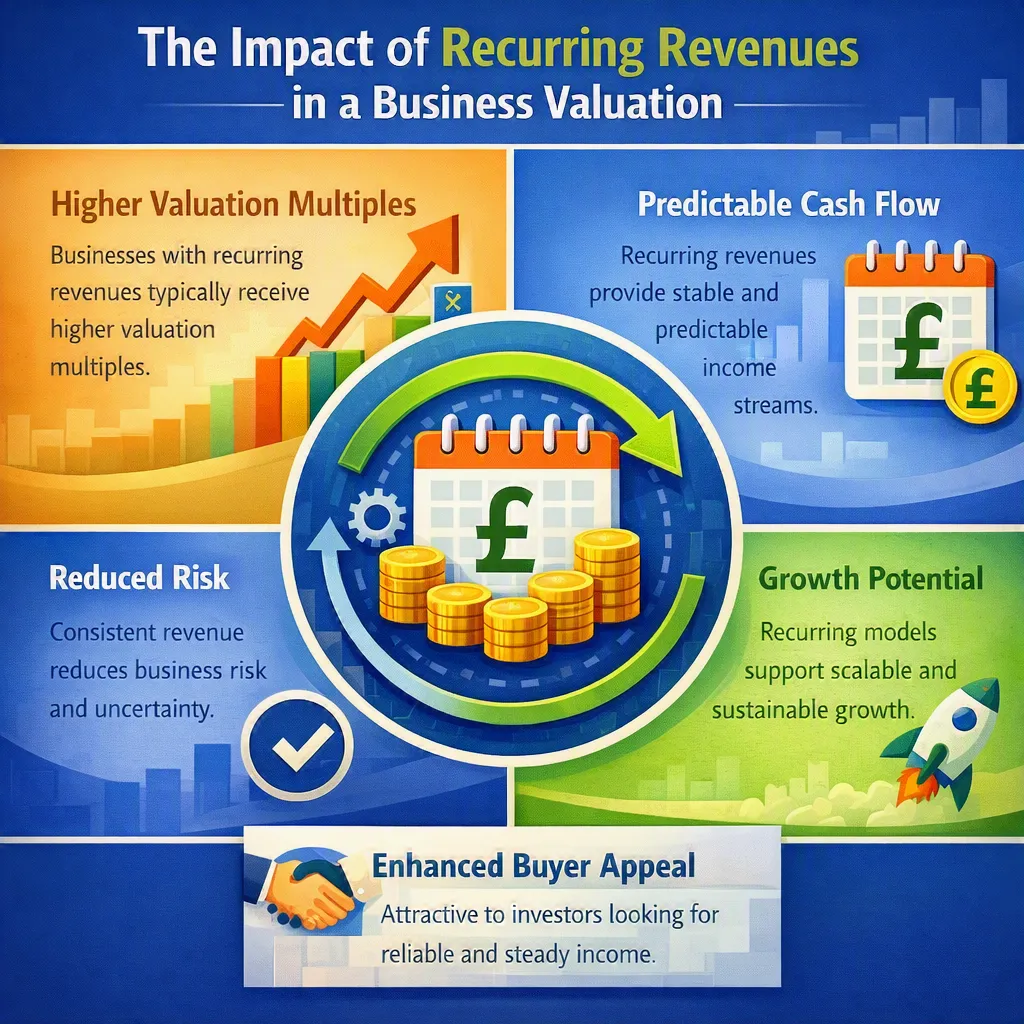
Recurring Revenue & Business Valuations: Why Subscription and Contracted Income Commands a Premium (and How to Build It)
If you want to understand the single most powerful lever for increasing the value of a UK SME business, it is this: the proportion of revenue that is recurring, contracted, and predictable. Not revenue growth. Not margin improvement. Not headcount reduction. Revenue quality — the degree to which the income a business generates in one year is structurally likely to continue in the next.
Buyers pay more for certainty than for scale. A business generating £800k of EBITDA from a stable, contracted subscription base is worth more than a business generating £1.2m of EBITDA from transactional, one-off work that must be re-won continuously. The earnings multiple applied to the first business reflects the certainty that the income will continue. The multiple applied to the second business reflects the risk that it might not. That difference in multiple — applied to the earnings of two businesses that might look superficially similar — can represent hundreds of thousands of pounds in total enterprise value.
This post examines why recurring revenue commands a structural valuation premium, how buyers assess the quality of a recurring revenue base, the specific characteristics that determine whether claimed recurring revenue is genuine or superficial, and what business owners can do — practically, over time — to shift their revenue mix in ways that create real and lasting valuation uplift.
Why Recurring Revenue Is Valued More Highly
When a buyer acquires a business, they are making a bet about the future. Specifically, they are betting that the earnings they are paying a multiple for will continue — and ideally grow — during the period they intend to own the business. That bet is more confident when the revenue base is contracted and sticky than when it is transactional and relationship-dependent.
The financial logic is straightforward. A business with 80% of revenue under multi-year contracts has a high degree of revenue visibility. The buyer can look twelve to eighteen months forward with reasonable confidence about the income that will arrive — which means the investment model is built on a relatively firm foundation. A business with 20% of revenue under contract and 80% on a transactional basis has much lower forward visibility. The buyer must make stronger assumptions about future revenue, which introduces more model risk, which is reflected in a lower multiple.
There is also a risk of disruption specifically around the change of ownership. In any acquisition, there is a period when customers may reassess their relationships — deciding whether the new owner represents the same quality and continuity as the previous one. For a contracted customer, that reassessment happens at renewal time, not immediately. For a transactional customer, it can happen any time. A business with high contractual lock-in is therefore significantly less vulnerable to customer attrition in the transition period — which is one of the highest-risk phases of any acquisition.
What Genuine Recurring Revenue Looks Like
Not all revenue that is described as recurring is genuinely recurring. Buyers have become increasingly sophisticated about this distinction, and a claim of recurring revenue that cannot be substantiated in the contract documentation will be exposed in due diligence. It is worth being precise about what genuine recurring revenue actually means.
True subscription or SaaS revenue
The highest-quality form of recurring revenue is genuine subscription billing — a fixed periodic charge that continues automatically until the customer explicitly cancels. Software-as-a-Service businesses are the archetype. The customer signs up, a direct debit or card is authorised, and the revenue continues month after month without any further action required from either party.
What makes this revenue so valuable: it is genuinely automatic, it has low churn relative to transactional revenue, and the unit economics typically improve over time as the customer base grows without a proportional increase in delivery cost. Buyers value SaaS revenue at the highest multiples in the market because the forward visibility is the clearest and the structural risk of losing it in any given year is the lowest.
Multi-year service contracts
Professional services, outsourced business functions, and managed services businesses often operate on multi-year contracts — typically one to three years, sometimes longer — where the customer commits to a defined scope of service at a defined price for the contract term. This revenue is highly recurring in the economic sense: it will continue unless the customer takes positive action to end or renegotiate it at renewal.
The valuation premium for multi-year contracted revenue depends on the average remaining contract term, the renewal history, and the contractual protections around early termination. A managed services business with an average remaining contract term of 22 months and a 90% renewal rate presents a very different risk profile from one with contracts averaging 4 months to run and a 70% renewal rate — even if the headline revenue figure is identical.
Retainer arrangements
Retainer income — where a client pays a fixed monthly amount for ongoing access to services — sits slightly below multi-year contracts in the recurring revenue quality hierarchy. Retainers are typically on month-to-month or annual rolling terms rather than fixed multi-year commitments, which means the customer can end the arrangement relatively easily. But well-established retainer relationships with long-tenure clients are genuinely sticky — the combination of relationship inertia, switching cost, and embedded value means that retainer income is significantly more durable than transactional income even in the absence of formal contractual lock-in.
The key metrics buyers assess for retainer income: average retainer tenure (how long have these relationships been in place?), the concentration of retainer income (is it distributed across many clients, or dependent on two or three?), and the renewal history (what percentage of retainers are still in place twelve months after they started?).
What recurring revenue is not
A customer who has bought from the business every year for the last five years is not a recurring revenue customer in the valuation sense unless they are under a contract that commits them to continue doing so. Repeat purchasing is a positive commercial signal, but it is not contractual commitment, and buyers distinguish between the two clearly.
Similarly, a business that calls its revenue recurring because most of its customers come back — but where there is no contract, no subscription, and no structural barrier to those customers going elsewhere at any point — is not a recurring revenue business in the sense that commands a premium multiple. The premium is for structural certainty, not for historical pattern.
How Buyers Assess the Quality of a Recurring Revenue Base
When a buyer reviews a business that claims recurring revenue, the due diligence process will assess the following specifically:
The revenue retention rate
Revenue retention rate measures what percentage of the prior year's revenue base has been retained in the current year — before any new business. A business with £1m of revenue last year and £920k from the same customers this year has a gross revenue retention rate of 92%. This metric tells the buyer how durable the existing revenue base is and provides the foundation for modelling future revenue under different growth and churn assumptions.
Net revenue retention — which includes expansion revenue from existing customers who have bought more — can exceed 100%, meaning that even if some customers churn, the growth in spend from the remaining customers offsets the losses. Net revenue retention above 100% is one of the most compelling valuation signals in any recurring revenue business.
The contract documentation
Claimed recurring revenue that is not supported by signed contracts is not recurring revenue for valuation purposes. The buyer's solicitor will review the contract documentation as part of legal due diligence, and any contract that is unsigned, expired, or materially different from how it is described in the IM will be flagged. Sellers who describe revenue as contracted without the contracts to support that description will face credibility damage in due diligence that affects the price and sometimes the deal.
The renewal history
Historical renewal data — what percentage of contracts that came up for renewal in each of the last three years were actually renewed, and at what price — is one of the most revealing metrics in any recurring revenue business. A renewal rate that has been consistently above 90% over three years is strong evidence that the revenue base is genuinely sticky. A renewal rate that has declined over the same period, or that shows material variation between years, is a question that needs answering before a premium multiple is justified.
The customer concentration within recurring revenue
Even contracted, recurring revenue is not immune to concentration risk. A managed services business where 50% of its contracted revenue is with one client has a significant vulnerability at that client's renewal date — and that vulnerability affects the multiple regardless of the contractual commitment. Buyers will assess the distribution of recurring revenue across the customer base and apply a discount where concentration is high, even in contracted income streams.
Building Recurring Revenue Before Going to Market — What Is Achievable
For business owners thinking about exit in the next two to five years, shifting the revenue mix towards a higher proportion of recurring income is one of the highest-return preparation activities available. It is not always straightforward — some business models lend themselves to recurring revenue more readily than others — but the commercial creativity required is usually less than owners initially assume.
Introducing retainer or service contract options
The most accessible route to recurring revenue for most service businesses is introducing a retainer or service contract option for existing customers. Customers who are already buying from the business regularly, who value the relationship, and who would benefit from the certainty of a known monthly cost are often willing to convert to a retainer arrangement — provided it is priced fairly and offers them something they value in return.
The value to the customer: certainty of cost, priority access to the service, and often a modest discount relative to ad hoc purchasing. The value to the business: revenue visibility, improved cash flow predictability, and a valuation premium at exit. That is a genuinely mutual exchange that most established customer relationships can accommodate.
Annual contracts instead of project pricing
For businesses that currently price on a project-by-project basis, moving to annual contract arrangements — where the customer commits to a scope of work for the year at a fixed or capped price — converts transactional revenue into contracted revenue without changing the fundamental nature of what is delivered. The customer gets budget certainty. The business gets revenue visibility and a higher multiple at exit.
This conversion is most achievable with customers who already engage with the business consistently across multiple projects each year, where an annual arrangement simply formalises what is already happening commercially. The conversation is not a difficult one in most established relationships — it is typically welcomed by customers who value the relationship and want the planning certainty an annual arrangement provides.
Productising recurring elements of service delivery
In professional services businesses, there are often recurring elements of service delivery — quarterly reporting, annual reviews, compliance updates, system maintenance — that are currently delivered as part of a broader relationship without being specifically priced or contracted. Identifying those recurring elements, productising them as a defined service tier, and pricing them on a subscription or retainer basis converts what was previously implicit into explicit contracted recurring revenue.
This requires a degree of commercial confidence — the willingness to put a price on something that has previously been delivered informally — but most clients accept it readily when the service is presented clearly and the pricing is reasonable. And the effect on the business's revenue quality, and therefore its valuation, can be material even when the individual amounts are modest.
The timeline for recurring revenue to affect valuation
Revenue that has been recurring for less than twelve months is given limited weight in a valuation — a buyer wants to see at least one full renewal cycle before treating contracted income as genuinely validated. Revenue that has been recurring for two or three years, with documented renewal history, commands the full multiple premium. This means that the work to build recurring revenue needs to start at least two years before the planned exit — which is another argument for starting exit preparation earlier than most owners instinctively do.
The Valuation Gap Between Transactional & Recurring Businesses
To make the valuation impact of recurring revenue concrete, consider two businesses in the same sector with identical normalised EBITDA of £500k:
Business A: 75% of revenue is transactional, re-won project by project. Revenue retention rate 78%. No long-term contracts. Applicable multiple: 3.5x to 4x. Enterprise value: £1.75m to £2m.
Business B: 70% of revenue is under multi-year service contracts with an average remaining term of 18 months and a 91% renewal rate. Revenue retention rate 94%. Applicable multiple: 5x to 6x. Enterprise value: £2.5m to £3m.
The EBITDA is identical. The valuation gap is between £500k and £1.25m — representing the difference that revenue quality alone creates in enterprise value, before any other business characteristic is considered. For a business owner, that gap is the most compelling financial argument for the hard work of shifting the revenue mix before going to market.
Download the Dealwise Business Valuation Playbook for a detailed framework on how revenue quality — alongside the other four value drivers — is assessed and priced in any UK SME transaction.
Download the Business Valuation Playbook at www.DealwiseAdvisory.co.uk
Contact Steve at [email protected] for a frank conversation about your business's revenue quality and valuation position
WhatsApp Steve on +44 7930-857243