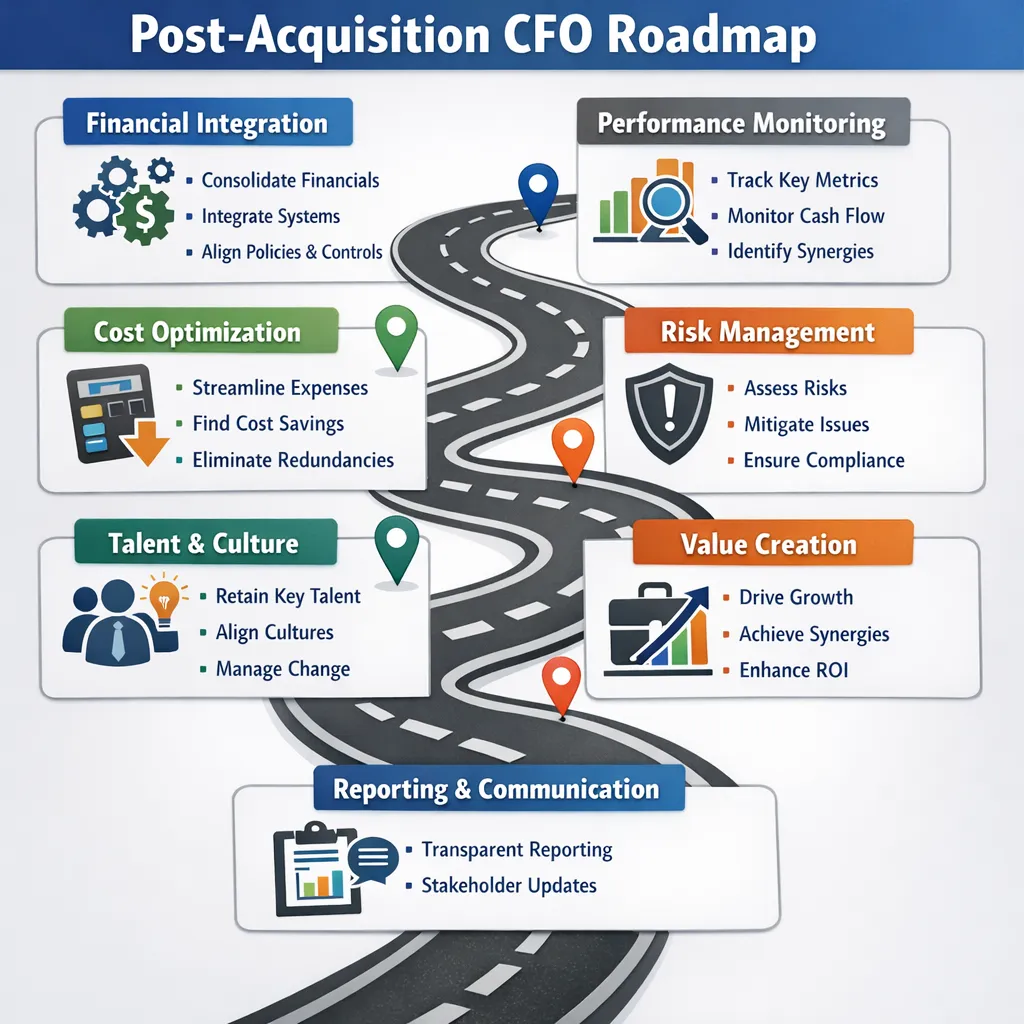
The Post-Acquisition CFO Playbook: How to Build Financial Control and Create Value in the First 12 Months
Most of the content written about business acquisitions is focused on the transaction — how to find the deal, how to value it, how to structure it, how to get it over the line. Very little is written about what happens after completion, which is where the real work begins and where most of the value is either created or destroyed.
The first twelve months of ownership are the most critical period in any acquisition. The decisions made in that window — about financial reporting, about the cost base, about the management structure, about which opportunities to pursue and which to close down — shape the trajectory of the business for years. Get them right and you compound from a strong foundation. Get them wrong and you spend years correcting problems that were created in the first few months.
This post is the CFO playbook for that first year. It is written from the perspective of someone who has sat in the seat — as a CFO in acquired businesses and as an adviser to buyers going through that transition — and it covers the specific actions, in sequence, that produce the best outcomes.
The First 30 Days: Understand Before You Change
The single most common mistake new owners make in the first month is moving too fast. The business looks different from the inside than it did during due diligence. There are things you did not know, people you have not properly assessed, processes you do not yet understand. The instinct to make your mark immediately — to restructure, to cut costs, to impose new systems — is understandable. Resisting it is one of the highest-value things you can do in month one.
The first thirty days should be almost entirely diagnostic. Your job is to understand the business as it actually operates, not as it was presented in the information memorandum.
Understand The Real Cost Base
The cost base you inherited may be different from the one you modelled. Some costs that appeared in the accounts were understated — the owner was filling roles that now need proper resourcing. Others were overstated — personal expenses or inefficient supplier contracts that can be addressed. You need a line-by-line view of every material cost, what it is for, whether it is contracted, and whether it is genuinely necessary at its current level. This takes time to do properly. Do not shortcut it.
Build Your Financial Reporting Baseline
You cannot manage what you cannot measure. In the first thirty days, establish what financial reporting actually exists — not what the seller said existed, but what you can physically produce right now. In many acquired businesses, particularly at the smaller end of the SME market, management reporting is less developed than the due diligence process suggested. Understanding the gap between where reporting is today and where it needs to be is a day-one priority.
Meet The Key People (Properly!)
The people who matter most to the short-term performance of the business are not always the ones at the top of the org chart. In the first thirty days, identify who the real operational lynchpins are — the people whose departure would cause the most disruption — and invest time in those relationships. Not to make promises you cannot keep, but to understand their motivations, their concerns, and their view of the business. The information you get from these conversations is often more valuable than anything that emerged from formal due diligence.
Stabilise Key Relationships
Customers, suppliers, and banking relationships all need early attention. A brief, professional communication to key customers — introducing yourself, confirming continuity of service, and inviting a conversation if they have questions — goes a long way towards managing the transition anxiety that a change of ownership naturally creates. Do not leave key relationships to wonder what the change means for them. Fill the information vacuum before rumour does.
Days 31 to 90: Build the Control Framework
Once you have a clear picture of what you have bought and how it operates, the second phase is about building the financial control and reporting infrastructure that will underpin everything else. This is the CFO work — the unglamorous, essential scaffolding that allows you to make good decisions, spot problems early, and create the evidence base that supports the business's eventual sale at a premium.
Implement Monthly Management Accounts
If the business does not already produce monthly management accounts, this is the most important financial infrastructure change you can make. Monthly accounts — produced within ten to fifteen working days of month end — give you a current view of performance against budget, a trend line for revenue and margin, and early warning of cash flow issues before they become crises. They also create the financial history that a future buyer will want to see.
The management accounts pack should include, at minimum: a profit and loss account versus budget and versus prior year; a balance sheet; a cash flow statement; a working capital analysis showing debtors, creditors, and stock versus prior months; and a commentary explaining the key variances. This is not complex. But it is essential.
Build a Rolling Cash Flow Forecast
A thirteen-week rolling cash flow forecast — updated weekly — is the single most powerful financial management tool available to a business owner. It tells you when cash is tight before the bank account tells you. It lets you plan around large payments, tax dates, and seasonal working capital peaks. It gives you the lead time to arrange facilities or take action before a cash constraint becomes a cash crisis.
Many of the businesses I have worked with post-acquisition have had no cash flow forecasting at all. The previous owner knew the cash position intuitively — from years of experience. That knowledge does not transfer with the business. Building the forecast discipline in the first ninety days is non-negotiable.
Review the Banking and Financing Structure
The banking relationship you inherited may not be the right one going forward. Review the existing facilities — their cost, their terms, their suitability for your plans — within the first ninety days. If you have acquisition debt that is priced above current market rates, or facilities that constrain the operational flexibility you need, addressing this early is better than carrying an inefficient financing structure for years.
If invoice finance was part of your acquisition funding structure, ensure it is operating as expected and that the facility limits are appropriate for the working capital requirements of the business. Invoice finance facilities often need adjustment in the first few months as the lender builds a track record with the new ownership.
Establish Your Budget for the First Full Year
If you completed the acquisition part way through a financial year, build a budget for the remainder of that year and the full first year under your ownership as quickly as possible. The budget is not just a financial planning tool — it is a communication document. It tells your management team what the priorities are, what the performance expectations are, and what success looks like. A business operating without a budget is a business operating without a compass.
Months 4 to 6: Identify and Execute the Quick Wins
By month four, you should have a clear enough picture of the business to identify the two or three operational or commercial changes that will have the most impact on performance in the near term. These are the quick wins — improvements that are relatively straightforward to implement, produce visible results quickly, and build momentum and confidence in the management team.
The quick wins that appear most consistently across acquired businesses:
Pricing Review
Many owner-managed businesses have not reviewed their pricing systematically for years. The owner set prices at a level that felt right, customers accepted them, and inertia did the rest. In a significant proportion of acquisitions, there is pricing power that has not been exercised. A structured pricing review — looking at margin by customer, by product or service line, and by revenue category — often reveals opportunities to increase revenue without increasing cost. Even a 3% to 5% price improvement across the base can have a material impact on EBITDA.
Cost Base Rationalisation
With a full understanding of the cost base from your month-one diagnostic, identify the costs that are genuinely unnecessary or inefficient. Supplier contracts that have never been renegotiated. Subscriptions that nobody uses. Insurance policies that have renewed automatically without review. Premises costs that reflect a previous operational model rather than the current one. These are not dramatic cuts — they are the result of applying fresh eyes to a cost base that has accumulated over years without systematic review.
Revenue Mix Improvement
Look at the revenue mix through a margin and quality lens. Which customers, products, or service lines are generating the highest margin and the most reliable recurring income? Which are high-revenue but low-margin, or transactional and uncertain? An active effort to rebalance the revenue mix towards higher-quality income — even over a twelve to eighteen month horizon — improves both the immediate profitability and the eventual sale multiple of the business.
Working Capital Optimisation
In most acquired businesses, there is working capital efficiency to be found. Debtor days that are higher than they need to be because collections have not been actively managed. Stock levels that are higher than optimal because nobody has reviewed the reorder logic. Payment terms to suppliers that could be extended. A focused working capital improvement programme — even one that recovers thirty days of debtor days — can release significant cash from the operating cycle of the business without any effect on revenue.
Months 7 to 12: Build for the Future
The second half of the first year is where the foundation work of the first six months starts to compound. With financial control in place, quick wins delivered, and a clear picture of the business's operational dynamics, the focus shifts to the medium-term value creation agenda.
Strengthen the Management Team
By month seven, you should have a clear view of which members of the management team are performing at the level required and which have gaps that need addressing. Difficult personnel decisions that were avoided in the first six months — while you were still in listening mode — need to be made now. The management team you need to grow and eventually sell the business may not be exactly the one you inherited. Building it takes time, and the time to start is before you need it urgently.
Invest in the Reporting Infrastructure
The management accounts and cash flow forecast you built in months one to three are the foundation. By month seven, you should be building on them — adding the KPI reporting that gives you early visibility of operational performance, the customer-level profitability analysis that informs commercial decisions, and the forward-looking financial model that supports strategic planning and future financing conversations.
The quality of your financial reporting is not just an internal management tool. It is a signal to future buyers, lenders, and investors about the quality of the business's governance. A business that can produce clean, timely, well-structured financial information consistently is worth more than one that cannot — not because the information changes the underlying performance, but because it reduces the perceived risk for anyone assessing the business from the outside.
Build the Value Creation Roadmap
At the twelve-month mark, step back and assess where the business is relative to where you planned it to be. What has improved? What has not moved as expected? Where are the biggest remaining opportunities? This assessment — done honestly and with specific financial evidence — is the basis for the next planning cycle and, if you are beginning to think about exit, the basis for the value creation roadmap that will shape the next two to three years of ownership.
The businesses that sell at the best multiples are the ones where the new owner has demonstrably improved performance in the years after acquisition. Financial buyers and strategic acquirers both pay premiums for businesses with upward-trending financial history — not just strong absolute numbers. Every month of well-managed ownership is building the evidence base that your eventual sale will rely on.
The Financial Infrastructure That Pays Dividends Twice
Everything in this playbook serves two purposes simultaneously. First, it makes the business better to own and operate — more profitable, more cash-generative, more resilient. Second, it builds the financial history and governance infrastructure that a future buyer will pay a premium for.
The acquisition entrepreneur who builds strong financial control from day one is not just running a better business in the present. They are building a more valuable asset for the future. Those two things are not in tension — they are the same work, producing returns at two different time horizons.
If you want to discuss the specific financial control and value creation priorities for a business you have recently acquired — or a business you are about to acquire — get in touch directly.
Take the Acquisition Readiness Scorecard at www.DealwiseAdvisory.co.uk
Contact Steve at [email protected] to discuss your post-acquisition strategy
WhatsApp Steve on +44 7930-857243