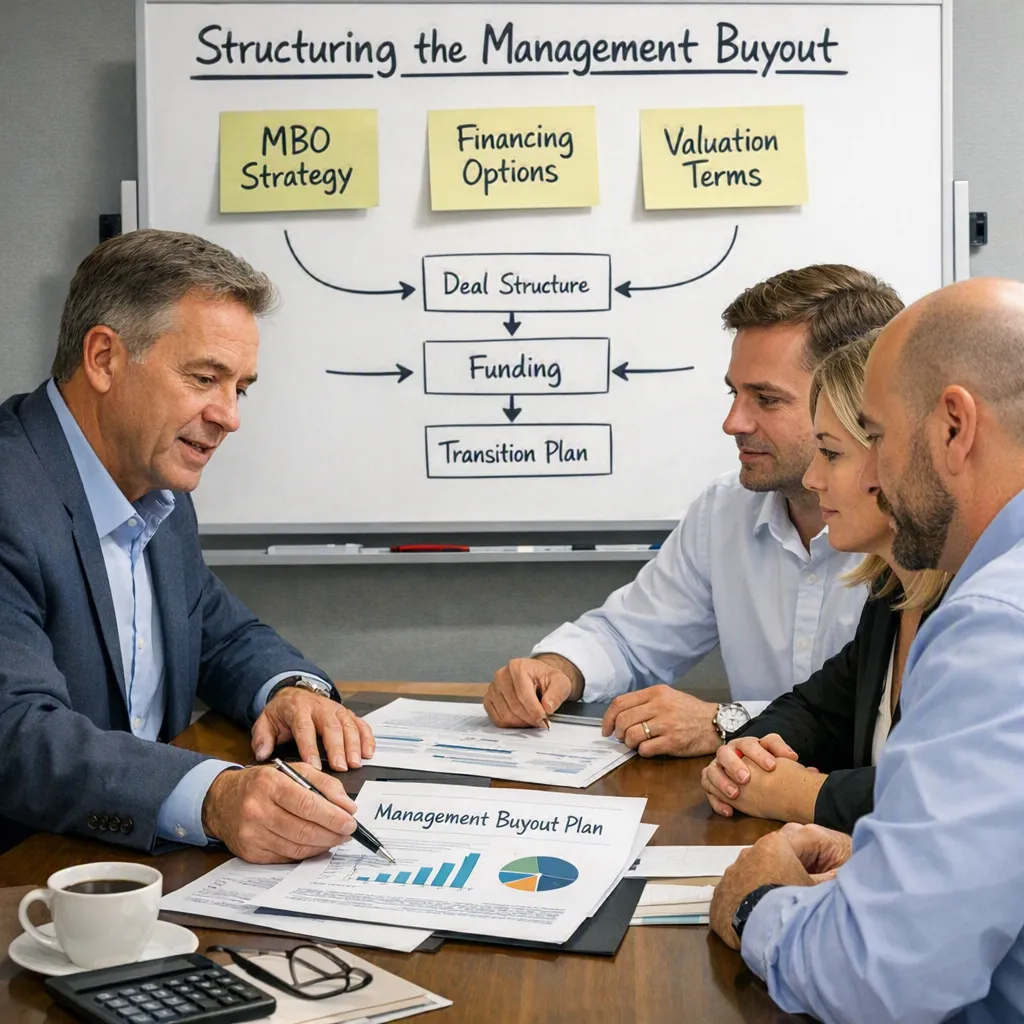
The Management Buyout as an Exit Route: When It Works, How to Structure It, and What Owners Get Wrong
Most business owners, when they think about selling, think about finding an external buyer — a trade acquirer, an acquisition entrepreneur, a private equity-backed consolidator. The assumption is that the best price and the cleanest exit come from the open market, where competitive tension produces the highest offer.
That assumption is often correct. But it is not universal. For a significant proportion of UK SME owners — particularly those who have built strong, capable management teams and for whom the future of their people and culture matters as much as the financial outcome — the management buyout is a genuinely superior exit route. Not always. Not for every business. But in the right circumstances, an MBO produces a better outcome for the owner, the management team, and the business than any external sale could achieve.
This post explains what a management buyout is, when it makes sense as an exit route, how it is typically structured and funded, and the specific mistakes that owners make when selling to their management team. It is written for business owners who are either considering an MBO or who want to understand the option properly before deciding it is not for them.
What a Management Buyout Actually Is
A management buyout is a transaction in which the existing management team of a business acquires a controlling or majority interest in it from the current owner. The management team becomes the new owners, typically alongside one or more financial backers who provide the capital the management team cannot fund personally.
MBOs are not a single transaction structure — they exist on a spectrum. At one end is a simple vendor-financed MBO where the owner lends the entire purchase price to the management team and is repaid from the business's future cash flows. At the other end is a heavily leveraged, private equity-backed transaction where an institutional investor takes a significant equity stake alongside the management team and provides the debt and equity capital required for a large transaction.
The vast majority of UK SME MBOs sit somewhere in the middle — a combination of bank debt, vendor finance from the exiting owner, and personal equity from the management team themselves. Understanding how those components interact, and what determines the feasibility of the structure, is the starting point for any MBO conversation.
When an MBO Makes Sense as an Exit Route
An MBO is worth considering seriously when several conditions are present simultaneously. Not all of them need to be present — but the more of them that apply, the more compelling the case for exploring an MBO alongside or instead of a traditional sale process.
A capable, motivated management team in place
This is the non-negotiable condition. An MBO requires a management team that is genuinely capable of running the business independently — with real operational decision-making authority, genuine commercial relationships, and the financial literacy to manage the business's performance without the owner's involvement. A team that has been operating as implementers of the owner's decisions, rather than as autonomous managers, is not ready for an MBO regardless of how loyal or well-intentioned they are.
The management team also needs to be genuinely motivated to own the business — not just to continue working in it. Ownership involves personal financial risk, longer-term commitment, and a fundamentally different relationship with the business's performance than employment does. Managers who want the security of senior employment without the risk of ownership are not the right profile for an MBO buyer. The owner needs to have an honest conversation with the team about what ownership actually involves before any formal process begins.
The owner cares about legacy and continuity
One of the most consistent themes in owner-managed businesses is that the owner's relationship with the business extends beyond the financial. They have built something. The people who work there matter to them. The culture they have created, the relationships with customers and suppliers, the way the business operates — these things have value in the owner's mind that is separate from and sometimes more important than the sale price.
An MBO preserves all of those things in a way that an external sale frequently does not. A trade acquirer may integrate the business into a larger group, changing the culture, rationalising the headcount, and rebranding the products. An acquisition entrepreneur may have a different vision for the business's direction. A management team that has been part of the culture understands and cares about what has been built in a way that no external buyer can match.
For owners who care genuinely about continuity, and who are prepared to accept a potentially lower price than a competitive external sale might generate, the MBO is often the exit that they look back on most positively — not because the financial outcome was superior, but because the business continued in the way they wanted it to.
The business is fundable on its own cash flows
An MBO is a leveraged transaction — the purchase price is funded primarily by debt secured against the acquired business, serviced from its future cash flows. This means the business must generate sufficient free cash flow to service the acquisition debt at the required interest rate, maintain adequate working capital, and fund ongoing operations — simultaneously.
The debt service coverage ratio (DSCR) — annual free cash flow divided by annual debt service — needs to be at least 1.25x to 1.5x for most MBO lenders to be comfortable. A business generating £300k of free cash flow per year can support approximately £200k of annual debt service at current rates — which, at a 6% interest rate on a seven-year term, implies acquisition debt of approximately £1.1m to £1.2m. If the business is valued at significantly more than that, the gap needs to be filled by personal equity from the management team and vendor finance from the owner.
A realistic price expectation from the owner
MBOs almost always complete at a price below what the same business might achieve in a competitive external sale process. The reasons are structural: the management team has limited personal capital, the funding available is constrained by the business's cash flows, and there is no competitive tension between multiple bidders driving the price upward.
Owners who approach an MBO expecting to achieve the same price as a trade sale are usually disappointed, and sometimes damage the management team relationship in the process. The right frame is: the MBO offers certainty, continuity, speed, and the avoidance of the disruption of an external sale process, in exchange for a price that is typically 10% to 25% below what a competitive process might deliver. That trade-off is worth different amounts to different owners depending on their personal priorities.
How an MBO Is Typically Structured and Funded
The funding structure for a UK SME MBO typically combines four sources of capital in varying proportions depending on the business's cash generation, the management team's personal resources, and the owner's appetite for vendor finance.
Senior debt: the primary funding source
Senior debt, provided by a clearing bank or specialist MBO lender, is typically the largest component of MBO funding. Most MBO lenders will lend between two and three times EBITDA for a well-run SME business, secured against the business's assets and cash flows. The management team will be required to provide personal guarantees, and the lender will require detailed financial projections, management accounts, and a clear business plan for the post-MBO period.
The quality of the management team's financial presentation — their ability to present a credible, well-evidenced financial case for the business's future performance — is one of the primary determinants of the terms available from MBO lenders. A team that can articulate the business's performance clearly and in detail will consistently achieve better lending terms than one that relies on the departing owner to explain the numbers.
Vendor finance: the owner's role in funding the deal
In most SME MBOs, the owner provides a significant element of vendor finance — a loan to the management team that forms part of the purchase consideration and is repaid over a defined period from the business's cash flows. Vendor finance serves several purposes: it bridges the gap between what senior debt can provide and the total consideration, it keeps the owner financially engaged during the transition period, and it signals the owner's confidence in the management team's ability to run the business successfully.
The vendor loan is typically subordinated to the senior debt — the bank is repaid first — and carries an interest rate that reflects this higher risk position, typically 6% to 10%. The repayment period is usually three to five years. The security available to the vendor lender is limited, because the bank's senior debt is secured over the business assets. This means the vendor loan is largely unsecured or secured over residual assets — which is why the owner's confidence in the management team's capability is an essential precondition for accepting vendor finance as part of the MBO structure.
Management equity: skin in the game
The management team is expected to contribute personal equity to the deal — typically 5% to 15% of the total consideration, funded from their personal savings, mortgages, or other personal resources. The amount is less important than the principle: the management team needs to have genuine personal financial exposure to the business's performance after completion. This alignment of interests — the management team losing real money if the business underperforms — is what makes an MBO a fundamentally different proposition from employment.
The management equity contribution also has a psychological dimension that is easy to underestimate. The managers who have put their own money into the business behave differently from those who have not. The sense of ownership — genuine, personal, financial ownership — changes how people make decisions, how they manage costs, and how they respond to challenges. That change in mindset is one of the most reliable value creation mechanisms in any well-structured MBO.
Private equity: when institutional capital is involved
For larger MBOs — typically those above £5m in enterprise value — private equity or specialist MBO investment funds are often involved as financial backers. The fund provides equity capital alongside the management team, taking a significant minority or majority stake in exchange for its investment, with the expectation of a realisation of that investment within three to seven years.
Private equity involvement changes the nature of the MBO significantly. The fund will have a clear view on the return it requires and the timeline for achieving it. It will have governance requirements — board representation, financial reporting standards, strategic planning processes — that go well beyond what most SME management teams are accustomed to. And it will ultimately require a further exit event — a trade sale, a secondary buyout, or an IPO — within its investment horizon. For the management team, PE-backed MBO is a stepping stone, not a permanent ownership solution.
What Owners Get Wrong in MBO Processes
Not having the conversation early enough
The most common mistake owners make in MBO processes is not initiating the conversation until they are ready to sell — often with a compressed timeline that the management team cannot work within. An MBO requires the management team to raise personal finance, engage advisers, develop a business plan, and negotiate both with the owner and with lenders. That process takes three to six months in straightforward cases, and often longer. An owner who decides to sell and approaches the management team expecting to complete in two months is creating a timeline that is almost never achievable.
The right approach: if an MBO is a genuinely considered exit option, raise it with the key management team members twelve to eighteen months before the owner's intended exit date. Not as a formal negotiation, but as a genuine exploration — are you interested in owning this business? What would that look like? What would you need to make it possible? That conversation, had early enough, gives both parties the time to build the structure properly and the management team the time to get genuinely ready.
Pricing the MBO at external sale price
We have covered this above — but it deserves emphasis because it kills more MBO processes than any other single factor. An owner who has obtained a third-party valuation of the business at a full market multiple, and who then approaches the management team with that as the price, is starting from a position that is almost never fundable within the constraints of an MBO structure.
The price in an MBO needs to be set at a level that the business's cash flows can service after the debt required to fund it. That is a mathematical constraint, not a negotiating position. An owner who understands this — and who is genuinely motivated to do an MBO — will work with the management team and their advisers to find a price that is fundable, rather than insisting on a price that is not.
Not protecting the relationship during the process
The MBO negotiation is one of the most emotionally complex transactions in business — because it involves negotiating a commercial transaction with people the owner has worked with closely, often for years, and on whom the business's future depends. Getting the negotiation wrong — being too aggressive on price, creating adversarial dynamics, or making the management team feel undervalued in the process — can damage both the transaction and the working relationship in ways that take years to repair.
The owners who navigate this best keep the process clearly separated from the day-to-day management relationship. The negotiation is a commercial discussion between two parties with aligned interests — both want the business to thrive under new ownership — but with specific financial interests that need to be worked through. Keeping that distinction clear, and ensuring both parties have appropriate advisers so they are not negotiating directly on every specific point, protects the relationship while ensuring the deal is done properly.
Failing to plan for the transition
An MBO completes and the owner is out — or is supposed to be out. But the management team has never operated the business without the owner's daily presence. The customers still expect to see the owner at important meetings. The bank asks for the owner on important calls. The suppliers have relationships with the owner that they have not transferred.
The transition plan for an MBO needs to be as detailed as the financing structure. Who specifically is taking over which relationships? What is the timeline for the owner's withdrawal from operational involvement? How will the management team handle the first difficult situation they face without the owner available to resolve it? These questions need to be answered in the MBO agreement and tested in the transition period — not discovered post-completion.
The MBO Worth Doing
A well-structured MBO is one where the price is realistic and fundable, the management team is genuinely capable and motivated, the owner's continued involvement during the transition is clearly defined and time-limited, and both parties have appropriate advisers who understand the specific dynamics of an MBO rather than treating it as a standard external sale.
When those conditions are in place, an MBO can be the most satisfying exit a business owner makes — the business continues in capable, familiar hands, the culture is preserved, the people are protected, and the owner achieves a clean exit at a fair price. That combination is genuinely rare in any exit route. When an MBO delivers it, it tends to be the exit the owner looks back on most positively — regardless of whether it was the highest price they could theoretically have achieved.
Take the Exit Readiness Traffic Light at www.DealwiseAdvisory.co.uk
Contact Steve at [email protected] to discuss the MBO option for your business
WhatsApp Steve on +44 7930-857243