How to Find Off-Market Business Acquisition Opportunities in the UK and Evaluate Them Quickly
The best business acquisition opportunities in the UK are almost never on the open market. By the time a business appears on a broker's website with a polished information memorandum and a headline price, it has already been seen by every serious buyer in the broker's network, priced to generate competitive interest, and positioned to favour the seller. That is not where the best deals are made.
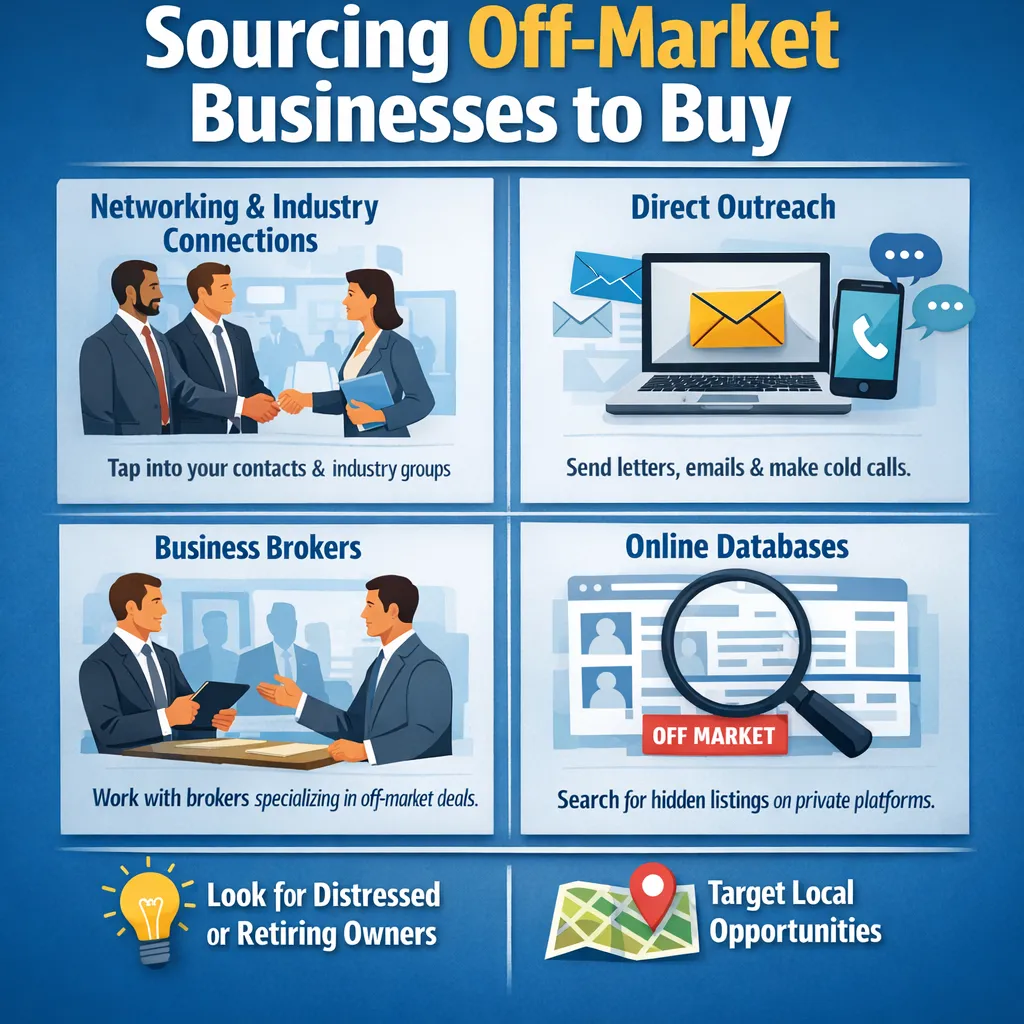
The most consistently successful acquisition entrepreneurs I know source a significant proportion of their deals off-market — through direct approaches, professional networks, and relationships built over time with business owners who were not yet thinking about selling. This post covers how to build that sourcing capability, what to do when a conversation with a potential seller opens up, and how to move quickly from first contact to a clear-headed initial assessment without wasting months on the wrong opportunity.
Why Off-Market Is Different; and Why It Is Worth the Effort
Off-market acquisition sourcing is harder than browsing business-for-sale platforms. It requires patience, consistency, and a willingness to have conversations that may not lead anywhere for months or even years. So why do experienced buyers invest in it?
Three reasons, and they compound.
First, less competition. A business that comes to you through a direct relationship has not been seen by every other buyer in the market. You are not competing on the same information against buyers who have all received the same IM and are all working to the same broker-managed timeline. That changes the dynamic of the negotiation — and often the price.
Second, better seller relationships. An owner who decides to sell to someone they have come to know and trust over time is typically a more cooperative seller than one who puts their business into a formal auction process. Better cooperation means smoother due diligence, more candid conversations about the business, and a higher likelihood of completion. In the deals I have found most straightforward to navigate, the buyer and seller had usually known each other for some time before the transaction conversation began in earnest.
Third, earlier access to quality. Some of the best businesses available for acquisition are owned by people who have not yet made the decision to sell — they are thinking about it, or they are open to the idea if the right conversation happens, but they have not committed to a formal process. Direct outreach, done thoughtfully and professionally, can open that conversation before a broker ever gets involved.
Building Your Target Universe
Effective off-market sourcing starts with a clear, specific picture of what you are looking for. Generic outreach — approaching businesses in any sector, of any size, in any geography — produces a lot of noise and very little signal. The buyers who do this well have a defined target profile and search deliberately within it.
Your target profile should specify:
Sector or sectors — where do you have transferable knowledge, credibility, or existing relationships? A buyer who can speak the language of a sector convincingly in the first conversation has a significant advantage over one who is approaching cold.
Revenue and EBITDA range — what size of business can you actually finance, manage, and add value to? Be honest. There is no point approaching businesses twice the size of what you can fund.
Geography — how close do you need to be to the business? For hands-on operators this matters more than for those comfortable with remote oversight.
Business model characteristics — recurring revenue, B2B, owner-managed, established customer base. The more specific your criteria, the more focused your sourcing.
Owner profile — businesses where the owner is approaching retirement age (typically 55 to 70) and where there is no obvious internal successor are statistically the most motivated sellers. This is a demographic reality in the UK SME market right now.
With a clear target profile, you can build a systematic list of businesses that fit it. Companies House is a free and underused resource — you can search by sector (SIC code), geography, and company age, and pull a list of registered companies that meet your criteria. This gives you the raw material for a direct outreach campaign.
How to Approach Business Owners Directly
Direct outreach to business owners who are not formally selling is sensitive territory. Done poorly — with a generic template, an obvious script, or a tone that makes the owner feel like a target rather than a professional — it produces defensiveness and closed doors. Done well, it opens conversations that can develop over months into genuine acquisition opportunities.
The principles of effective direct outreach:
Lead with relevance, not intention
The worst opening move is to tell an owner you are looking to buy businesses and you think theirs might be a fit. That immediately positions the owner as a seller — which they may not be ready to be — and puts them on the defensive. The better approach is to lead with something specific and relevant to their business: you have noticed their work in a particular market, you have a background in their sector, you are building in an adjacent space and are exploring partnership or collaboration. This starts a conversation rather than triggering a transaction reflex.
Be a real person, not a template
Business owners receive a lot of templated outreach. Letters that use their company name as a mail-merge field but are obviously generic. Emails that could have been sent to five hundred people. LinkedIn messages that are clearly automated. All of these go in the bin. The outreach that works is specific — it references something real about the business, the sector, or the owner's background. That specificity signals that you have done your homework and are genuinely interested, not just fishing.
Use the right channel
LinkedIn is the most effective channel for initial contact with business owners in the UK at the moment. A well-written connection request with a specific, relevant message — not a sales pitch — has a reasonable acceptance rate. A letter to the registered office, hand-addressed and professionally written, can work particularly well for older business owners who are less active on LinkedIn. A warm introduction through a mutual contact — accountant, solicitor, banker, sector contact — is by far the most effective channel when it is available.
Play the long game
Most direct outreach that eventually leads to a deal does not produce a transaction conversation immediately. It produces a friendly exchange, a connection, and a relationship that develops over time. The owner who receives your outreach today and is not thinking about selling may be a very motivated seller in eighteen months — and you will be the first person they think of if you have stayed in appropriate, professional contact in the interim. Follow up. Share relevant content. Stay visible without being pushy.
Using Professional Networks as a Sourcing Channel
Accountants, solicitors, corporate finance advisers, and business bankers all have relationships with business owners that give them advance visibility of potential sellers — often before those owners have decided to engage a broker or run a formal process. Building genuine relationships with these intermediaries is one of the highest-return sourcing activities available to a serious acquisition entrepreneur.
The key to making these relationships work is positioning yourself as a credible, prepared, committed buyer — not as someone who is vaguely interested and might do a deal one day. Intermediaries refer their clients to buyers they trust to handle the conversation professionally, move through a process efficiently, and actually complete. If you want deal flow from this channel, demonstrate those qualities consistently.
Practically:
Identify the accountancy firms, law firms, and corporate finance advisers who are most active in your target sector and geography
Make contact proactively — explain your acquisition criteria clearly and specifically
Follow up with evidence of your seriousness: the Acquisition Readiness Scorecard result, a one-page buyer profile document, proof of finance
When a referral comes through, respond quickly and handle it well — your reputation in the intermediary community is built one deal at a time
The Broker Market: How to Use It Without Paying for Everyone Else's Leftovers
Business brokers and business transfer agents are not the enemy of the acquisition entrepreneur. They are a legitimate part of the market — and for some buyers, particularly those who are newer to acquisitions and benefit from the structure a formal process provides, they are genuinely useful.
The challenge with the broker market is that the best businesses rarely linger. Brokers with strong networks sell quality opportunities quickly, often to buyers they already know. What stays on the market for months — the opportunities a new buyer finds when they first start browsing platforms — is typically either overpriced, has fundamental issues that put off informed buyers, or is simply the inventory that did not sell fast.
Used intelligently, the broker market is still worth engaging. Develop relationships with the two or three brokers most active in your target sector. Register as a buyer with a clear, specific brief. Review new listings quickly — if something fits your criteria, be one of the first to respond. And treat the broker professionally: they are advising the seller, not you, but a buyer who makes their life easier by moving decisively and communicating clearly will get better access to quality opportunities than one who is slow, vague, or difficult to deal with.
Evaluating an Opportunity Quickly: The First Assessment Framework
Whether a deal comes to you off-market or through a broker, the first task is the same: establish quickly whether this business is worth serious time and money. A structured initial assessment — done in hours, not weeks — tells you whether to proceed to formal due diligence or move on.
The five-question first assessment:
1. Does it fit the criteria?
Sector, size, geography, business model. If it does not fit the criteria you defined before you started looking, the question is why you are considering it. Criteria drift — gradually adjusting what you said you were looking for to accommodate opportunities that are available — is one of the most common mistakes in acquisition sourcing. Be disciplined.
2. Are the financials credible at first glance?
You do not need to conduct full financial due diligence at this stage. But a quick sense-check of the headline numbers — revenue, EBITDA margin, growth trend — tells you whether the business is performing at a level consistent with the asking price. A business claiming a 35% EBITDA margin in a sector where 12% is typical deserves an explanation before you proceed further.
3. Is there an obvious structural problem?
At first look, are there clear issues that would either kill the deal or require a fundamental renegotiation? Extreme customer concentration, an owner who is the entire business, a sector in structural decline, a lease with two years left and no renewal option. These do not necessarily mean no — but they need to be understood before you invest serious time.
4. Is the reason for sale plausible?
Retirement, health, desire to pursue other things — all legitimate. A reason for sale that does not quite add up — the owner who is 45 and says they want to retire, the business that has just had its best year ever and the owner wants to sell at the top — is worth probing before you go further. The reason for sale is not always what it appears, and understanding the real motivation matters for how you structure and negotiate the deal.
5. Can you see how you would add value?
This is the question that separates buyers who build businesses from those who buy and hope. Before you proceed beyond first assessment, have a clear view — even if it is provisional — of what you would do with this business in the first year of ownership. Where is the value creation opportunity? What is underdeveloped, underpriced, or underperforming that you have the skills and resources to improve? If the answer is nothing obvious, ask yourself why you are buying it.
From Conversation to Offer: Moving Deliberately Without Wasting Time
One of the consistent failure modes in acquisition sourcing is the buyer who has excellent conversations with business owners but never converts them into transactions. The conversation stays warm and exploratory indefinitely, and nothing moves forward — because neither party has ever made a clear proposal.
At some point, after the relationship has been established and the initial assessment has been done, the conversation needs to move. That means the buyer making a clear statement of interest — not an offer at this stage, but a clear expression of serious intent, with an indication of the parameters they are working within. That moves the conversation from exploratory to transactional, and gives both parties a basis for deciding whether to invest in the next stage.
Done well, this is not aggressive. It is professional. It respects the owner's time by being clear about what you are and are not offering. And it is the natural next step in a conversation that has been building genuine mutual interest.
Start Building Your Deal Pipeline
The buyers who close the best deals are not the ones who find them — they are the ones who have already built the relationships, the reputation, and the systematic sourcing process that means quality opportunities come to them before they go anywhere else. That infrastructure takes time to build. The right time to start is before you need it.
If you are not yet sure whether you are genuinely ready to start approaching business owners and evaluating opportunities, take the Acquisition Readiness Scorecard first. It will tell you where you are strong and where you have gaps to close — and give you a clear picture of what preparation looks like before you put yourself in front of a real opportunity.
Take the Acquisition Readiness Scorecard at www.DealwiseAdvisory.co.uk
Contact Steve at [email protected] to discuss your deal sourcing strategy
WhatsApp Steve on +44 7930-857243