Employee Ownership Trusts as a Business Exit Route: The Complete Guide for UK Business Owners
The Employee Ownership Trust has become one of the most discussed exit routes in the UK SME market since the tax incentives were introduced in 2014. The headline benefit — capital gains tax exemption on the sale of qualifying shares to an EOT — is genuinely significant and has attracted widespread attention. But the EOT is far more than a tax planning tool. It is a fundamentally different model of business ownership, and understanding what it actually involves — the governance, the funding mechanics, the ongoing obligations, and the specific circumstances in which it is the right choice — is essential before any business owner commits to this route.
This post is the complete guide for UK business owners considering an EOT. It covers how the trust works structurally, the specific tax benefits and their conditions, the profile of business that suits an EOT, the funding mechanics, the governance requirements, and the honest assessment of where the EOT is an excellent choice and where it is not.
What an Employee Ownership Trust Is
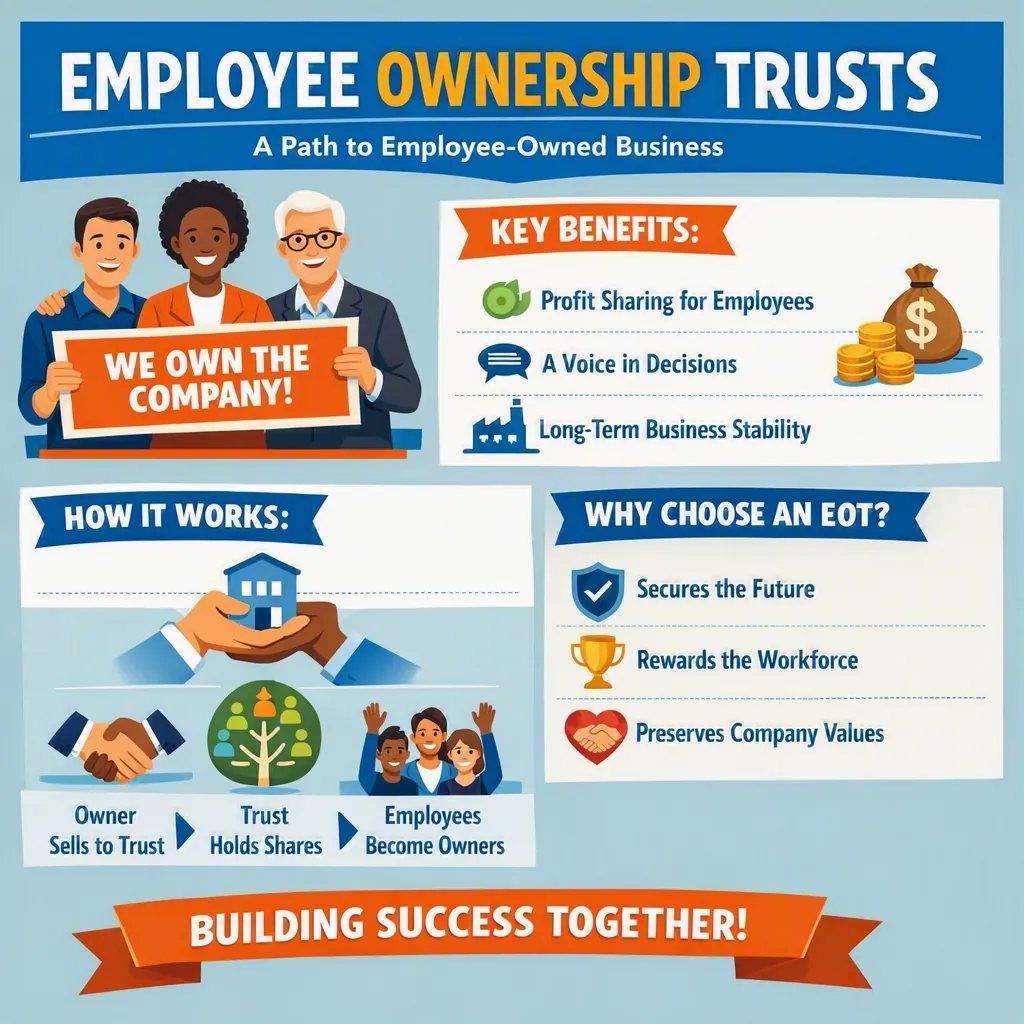
An Employee Ownership Trust is a discretionary trust that holds shares in a company on behalf of all employees. It is not employee ownership in the sense of individual employees holding shares — the shares are held collectively by the trust, for the benefit of the employees as a group, with no individual allocation of shares to specific employees.
When a business owner sells their shares to an EOT, they transfer ownership to this trust rather than to an individual buyer or a company. The trust then holds the shares indefinitely — unless the trustees decide to sell, which requires specific conditions to be met — and the employees benefit from the trust ownership through tax-free bonuses (up to £3,600 per employee per year under the EOT rules), profit sharing arrangements, and the cultural and motivational benefits of working in an employee-owned business.
The EOT structure was introduced by the Finance Act 2014, inspired in part by the John Lewis Partnership model, with the explicit policy objective of encouraging more businesses to transition to employee ownership as a succession route. The government's view was that employee-owned businesses tend to be more resilient, more productive, and better employers — and that the tax incentive was justified by those broader economic benefits.
The Tax Benefits — Specific and Conditional
Capital gains tax exemption
The most significant tax benefit of an EOT sale is the CGT exemption. When a business owner sells a qualifying controlling interest to an EOT, the gain on disposal is exempt from capital gains tax — entirely, with no limit. For a business owner selling shares that have increased significantly in value, this can represent a tax saving of 20% of the gain (or 10% where Business Asset Disposal Relief would otherwise have applied, up to the BADR lifetime limit).
To qualify for the exemption, the conditions are specific:
•The EOT must acquire a controlling interest — more than 50% of the ordinary shares
•The company must be a trading company or the holding company of a trading group at the time of disposal
•All employees must be entitled to benefit from the EOT on the same terms (though different amounts based on hours, length of service, or salary are permitted)
•The seller and their connected persons must not comprise more than 40% of the company's employees
•The EOT must not sell the shares for a period — there is a claw-back mechanism if the trust sells shares within the qualifying period
These conditions need to be met at the point of disposal and maintained thereafter for the exemption to be protected. Specialist tax advice is essential to confirm that all conditions are satisfied in any specific situation.
Income tax exemption on EOT bonuses
Once the EOT is in place, employees can receive annual bonuses of up to £3,600 per person free of income tax (though not free of national insurance contributions). This is a meaningful ongoing benefit for the workforce and a genuine financial advantage of employee ownership that complements the CGT exemption for the selling owner.
What changed in the Autumn 2024 Budget
The Autumn 2024 Budget introduced changes to the EOT rules that tightened the conditions in several respects. Sellers are now required to obtain advance confirmation from HMRC before completing an EOT transaction if they want certainty about CGT exemption status, and additional conditions around the independence of trustees have been strengthened. The rules also now require that the selling price paid by the EOT does not exceed the market value of the shares at the date of sale — an anti-avoidance measure targeting arrangements where the consideration was inflated to extract more value than the business's genuine worth.
Anyone considering an EOT as of 2025 needs specialist advice that takes into account the post-2024 rule changes. The basic structure and the core CGT exemption remain in place, but the specific conditions and the advance clearance process require careful navigation.
How the EOT Funds the Purchase Price
The EOT's central practical challenge is that it acquires shares in the company using money that the company itself must generate — because the trust typically has no external capital of its own. The funding mechanics work as follows:
At completion, the EOT acquires the shares from the selling owner. The seller receives an initial payment — funded by a combination of the company's existing cash reserves and, in many cases, bank debt arranged at the company level — and an ongoing deferred consideration structure payable over a defined period (typically three to seven years) from the company's future profits.
In practice, the selling owner accepts the majority of their consideration as deferred consideration rather than as a lump sum on completion. The company generates profits, those profits are used to make payments to the EOT, and the EOT uses those payments to repay the seller. The seller is effectively financing a significant portion of the purchase price themselves, receiving it over time from the business they have just sold.
This funding structure has direct implications for the price achievable in an EOT transaction. The business must be able to generate sufficient profits to service the deferred consideration payments over the agreed period — which means the effective price is constrained by the business's cash generation capacity, not by what a competitive external buyer might pay. In most EOT transactions, the price achieved is somewhat below what a well-run competitive sale process might deliver — a discount that the selling owner accepts in exchange for the CGT exemption and the other benefits of the EOT route.
The Governance of an Employee Ownership Trust
The EOT is governed by trustees — typically a combination of independent professional trustees, employee representatives, and sometimes the selling owner for a transitional period. The trustees hold the shares on behalf of the employee beneficiaries and have fiduciary duties to act in the best interests of all employees as a group.
The governance model of an EOT business is fundamentally different from an owner-managed or investor-backed business. Decisions that would previously have been made by the owner — significant capital expenditure, acquisitions, management appointments, dividend policy — now require trustee approval. The management team runs the business day to day, but major decisions are subject to trustee oversight.
This governance model has significant implications for the management team. The people who were previously employed by an owner now work in a business where the ultimate governance sits with a trust whose primary obligation is to all employees. That is a different dynamic — one that most employee-owned businesses find positive, but one that requires the management team to develop governance skills and transparency disciplines that an owner-managed business may not have needed.
The importance of independent trustees
The 2024 rule changes strengthened the requirement for independent trustees — people who are genuinely independent of both the selling owner and the management team, and whose primary obligation is to the employee beneficiaries. Trustee boards where the selling owner or their connected persons hold a controlling position are now more closely scrutinised, and structures that give the selling owner ongoing operational influence through the trustee board are specifically targeted by the anti-avoidance provisions.
Finding and appointing genuinely independent trustees — ideally with governance experience and an understanding of the employee ownership model — is one of the most important structural decisions in any EOT transaction. Professional trustees are available, but their involvement adds ongoing cost that the business must be able to absorb.
The Business Profile That Suits an EOT
Not every business is a good candidate for an EOT. The structure works best when several specific characteristics are present.
Strong, consistent cash generation
The EOT funding model requires the business to generate sufficient cash over a three to seven year period to repay the deferred consideration to the selling owner. A business with volatile or uncertain cash flows — highly cyclical, project-dependent, or exposed to significant working capital swings — creates real risk that the deferred consideration cannot be serviced reliably. EOTs work best in businesses with stable, predictable earnings.
A capable, motivated management team
In an EOT, the management team runs the business without the direct involvement of the previous owner. The quality, stability, and motivation of that team is therefore critical — not just for the business's performance, but for the governance of the trust and the effective management of the deferred consideration commitments. A management team that is not yet ready to operate independently is a higher risk in an EOT than in any other exit route.
A workforce that genuinely values ownership
The cultural benefits of employee ownership — the engagement, the sense of shared purpose, the connection between individual effort and collective reward — are real and have been documented in research on EOT businesses. But they require a workforce that understands and values what ownership means. In businesses where employees are transient, where there is high turnover, or where the workforce does not yet have a relationship with the business that would make ownership meaningful, the cultural benefit of the EOT is limited.
An owner for whom legacy matters as much as price
The EOT typically produces a lower total financial return than a well-run competitive sale process — the deferred consideration structure, the CGT saving notwithstanding, often results in a net present value below what a competitive sale would deliver. The owners who choose an EOT despite this are the ones for whom the legacy outcome — the business continuing in employee hands, the team being protected, the culture being preserved — is genuinely valuable enough to offset the financial cost.
That is a legitimate and respectable motivation. But it needs to be an honest one. Owners who choose an EOT primarily for the CGT benefit, while hoping to achieve the same total financial return as a competitive sale, are typically disappointed by the reality of the deferred consideration timeline.
EOT Versus Trade Sale Versus MBO — The Honest Comparison
Each of the three main exit routes has a specific profile of strengths and limitations:
Trade sale: highest financial return in most cases, competitive process creates genuine value, fastest capital realisation, but least control over outcome for the business and the people
MBO: preserves continuity and relationships, management team carries the business forward, seller has more control over the process, but price is constrained by the management team's funding capacity and typically below the trade sale level
EOT: CGT exemption is genuinely valuable for higher-value disposals, strongest legacy preservation, genuine cultural benefits for the workforce, but requires deferred consideration over multiple years, governance complexity, and a price that is typically below both trade sale and MBO alternatives
The right choice depends on the owner's specific priorities — financial outcome, timeline, legacy, employee welfare, and personal satisfaction with the exit — and on the specific characteristics of the business. In the right situation, an EOT is the most satisfying exit route available. In the wrong situation, it is an administratively complex way of achieving a financial outcome that could have been achieved more efficiently by a different route.
The Exit Readiness Traffic Light assessment covers the specific questions an owner needs to consider when evaluating which exit route is most appropriate — including the EOT viability assessment, the competitive sale readiness dimensions, and the MBO feasibility indicators.
Take the Exit Readiness Traffic Light at www.DealwiseAdvisory.co.uk
Contact Steve at [email protected] to discuss the EOT option for your specific business
WhatsApp Steve on +44 7930-857243