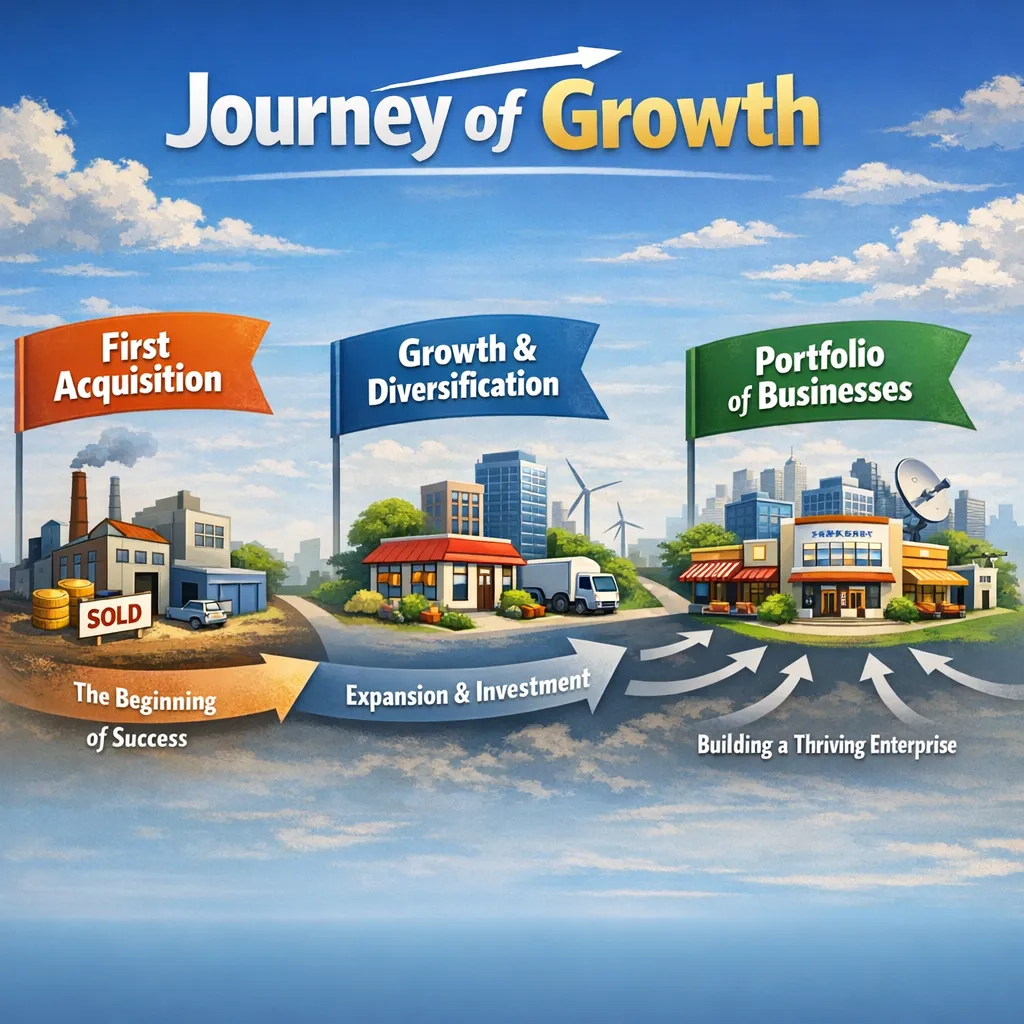
From First Acquisition to Portfolio: How to Think About Building a Group of Businesses Deliberately
Most acquisition entrepreneurs begin with a single deal. One business. The full focus of their attention, their capital, and their energy. That is entirely appropriate for the first acquisition — and getting the first business right, operationally and financially, is the foundation that everything else is built on.
But the most successful acquisition entrepreneurs do not stop at one. They think from early on — sometimes from before the first deal — about the portfolio they are building. Not as an abstract ambition, but as a deliberate strategy: which types of businesses to target, how they will interact within a group structure, how the capital generated by one business can fund the next, and what the overall portfolio looks like when it is eventually time to exit.
This post is about that portfolio mindset — how to develop it, what the practical building blocks of a deliberate acquisition portfolio look like, and the specific ways that the second and third deals are different from the first.
Why the Portfolio Mindset Matters From the Start
You do not need to be planning your second acquisition before you have completed your first. But having a portfolio framework in your thinking from the beginning changes the decisions you make in important ways.
It changes which first business you buy. An acquisition entrepreneur who is thinking in terms of a portfolio asks not just whether this is a good business to own, but whether it is a good platform business — one that generates cash, builds capability, and creates a foundation from which further acquisitions can be funded and managed. A business that is profitable but entirely owner-dependent, with no management infrastructure, is harder to use as a platform than one that has the operational structure to support additional growth.
It changes how you structure the first deal. A buyer thinking about a single acquisition optimises for the best deal on that business in isolation. A buyer thinking about a portfolio optimises for a corporate structure that facilitates future acquisitions efficiently — which typically means a holding company from day one, with the right tax and financing architecture in place before the second deal is contemplated.
And it changes the post-acquisition priorities. The first hundred days in any acquisition should include building the financial and operational infrastructure that will allow the business to run effectively with less owner involvement over time — because the owner needs to be available for the next acquisition. Building that infrastructure is both good business management and good portfolio strategy.
The Three Portfolio Models
Acquisition entrepreneurs who build deliberately tend to gravitate towards one of three portfolio models. Understanding which model fits your skills, resources, and objectives helps focus the acquisition strategy and avoid the trap of buying businesses that do not fit together.
The horizontal roll-up
A horizontal roll-up acquires multiple businesses in the same or closely adjacent sectors, consolidating them into a larger entity that commands better buying power, shared overhead, broader customer access, and ultimately a higher exit multiple than any of the constituent businesses would have achieved individually.
Roll-ups work well when the sector is fragmented — where there are many small, similar businesses that would benefit from the efficiencies and market position of consolidation. They require sector expertise from the acquirer, a clear operational integration playbook, and the management bandwidth to absorb multiple businesses within a relatively short period.
The exit logic for a roll-up is compelling: a business with £2m EBITDA assembled from five acquisitions at 4x is worth more at exit than the sum of those five businesses valued individually — because a larger business commands a higher multiple from a buyer who values the scale, the market position, and the reduced integration risk. The multiple arbitrage between the acquisition price and the exit multiple is one of the most powerful value creation mechanisms available to the acquisition entrepreneur.
The vertical platform
A vertical platform strategy acquires businesses at different points in a supply or service chain — building a group that controls more of the value chain and can therefore capture more margin, reduce dependency on external suppliers, and offer a more integrated proposition to customers.
This model is more complex than a horizontal roll-up because the businesses in the portfolio are fundamentally different from each other and require different operational expertise to manage. It rewards acquirers who have deep knowledge of a specific industry and can see how the value chain works end to end. The entry barriers to competitors are higher, but so is the management complexity.
The diversified portfolio
A diversified portfolio acquires businesses across different sectors with the primary objective of creating a resilient, cash-generative group of businesses that is not exposed to any single sector's cyclicality. The individual businesses operate largely independently. The holding company provides capital allocation, financial governance, and strategic oversight.
This model is often associated with family investment companies and private equity, but it is equally accessible to individual acquisition entrepreneurs with the right financial engineering knowledge and the right corporate structure in place. The challenge is that the portfolio manager's edge in a diversified model is financial and commercial acumen rather than sector expertise — which means the quality of the acquisition process and the post-acquisition financial discipline become the primary value creation levers.
What Changes Between the First and Second Deal
The second acquisition is categorically different from the first — not just in the practical sense that you now have less time and attention available because you are already running a business, but in the deeper sense that the risks and the decision-making process have changed.
You are risking more
Your first acquisition puts your capital and your time at risk. Your second acquisition puts all of that plus the business you already own at risk — because if you structure the second deal using debt secured against the first business, or if you drain the first business of cash to fund the second, a failure in the second acquisition can create problems in the first. Portfolio builders who do not think carefully about inter-entity risk exposure are sometimes surprised to find that a problem in one part of the group has contagion effects on the rest.
The discipline required for the second deal: ensure that the first business is genuinely stable and self-sustaining before you commit serious time to the next acquisition. The financial control framework from the post-acquisition CFO playbook should be in place and working. The management team should be capable of running operations without your day-to-day involvement. If neither of those things is true, the second acquisition is premature.
You know more — but you have less time
By the time you approach your second acquisition, you have real experience to draw on. You understand the process, you know what due diligence actually involves, you have a clearer view of the risks that matter most. That experience is genuinely valuable — it reduces the time and cost of the acquisition process and improves the quality of your decision-making.
What you have less of is time. Running one business is demanding. Running a process to acquire a second business simultaneously requires either significant delegation in the first business or a compressed personal bandwidth that creates risk in both. Most experienced portfolio builders are honest about this tension: the second acquisition typically takes longer than expected not because the process is harder, but because there is simply less time available to drive it.
The practical implication: build a longer timeline for the second acquisition than you think you need, and be explicit with yourself about which decisions and relationships in the first business require your personal involvement and which can be delegated during the acquisition period.
The structure of the second deal is more consequential
In your first acquisition, the structure of the deal matters primarily for that deal. In your second, the structure matters for the entire portfolio. The corporate structure through which you hold the second business, the financing arrangements, the tax treatment of the acquisition — all of these need to be considered in the context of the overall group, not just the individual deal.
This is where the holding company structure becomes essential. A well-designed holding company allows intra-group dividends to flow without personal tax events, creates the ability to borrow against the group's combined equity value for future acquisitions, and provides the structural foundation for a more efficient eventual exit — either of individual businesses or of the group as a whole.
If you did not establish a holding company before the first acquisition, the period between the first and second deals is the time to review whether a restructuring makes sense. The costs and tax implications of restructuring at this stage are real but generally manageable — and they are significantly lower than the cost of operating an inefficient structure for the subsequent decade.
Capital Allocation: The Core Portfolio Management Skill
Once you own more than one business, capital allocation becomes the primary management challenge. Every pound of cash generated across the portfolio has multiple potential destinations: reinvestment in the business that generated it, deployment into a new acquisition, debt repayment, personal income, or retained in the group as a buffer. Deciding which destination is right for which pound, at which time, is the skill that determines how quickly and how efficiently the portfolio grows.
The capital allocation principles that the best portfolio builders apply consistently:
Return on capital deployed — evaluate every capital decision against the expected return. Reinvestment in an existing business is justified when the expected return on that investment exceeds what the same capital would earn in a new acquisition. When a business requires capital to maintain rather than to grow, it is consuming capital rather than generating it — and that changes the strategic assessment of whether to hold or exit.
Debt management across the group — understand the total debt position of the group, not just each business in isolation. A group that appears profitable at the business level may be carrying a debt burden at the holding company level that constrains future acquisition capacity. Managing the group's combined debt service coverage ratio is as important as managing individual business profitability.
Cash pooling and treasury management — as the group grows, establishing a formal treasury function — even a simple one — that manages cash across entities, minimises idle cash in some businesses while others are cash-constrained, and ensures that financing costs are optimised across the group rather than managed entity by entity, creates real economic value.
The harvest and redeploy cycle — the most capital-efficient portfolio builders think in terms of a harvest and redeploy cycle: allowing cash-generative businesses to accumulate capital, then deploying that capital into the next acquisition at the right time. This cycle works best when the timing of acquisitions is driven by opportunity quality rather than capital availability — which requires maintaining a buffer of available capital rather than deploying everything immediately.
Building the Management Infrastructure for a Portfolio
The management infrastructure that supports a single business will not support a portfolio. As the group grows, the owner-manager who was previously the operational hub of a single business needs to transition into a more strategic role — setting direction, allocating capital, and providing governance oversight rather than managing day-to-day operations.
This transition is one of the most challenging aspects of portfolio building — and one of the most commonly underestimated. The skills that make someone an excellent business operator are not the same as the skills that make someone an excellent portfolio manager. The operational instinct — to get close to the problem, to make the decision directly, to be present in the business — can become a liability when applied to a group of businesses that need strategic oversight rather than operational management.
Building the management infrastructure for a portfolio involves:
Developing strong managing directors or general managers in each business who can operate with genuine autonomy — not just in the owner's absence, but as the normal operating model
Establishing a consistent financial reporting framework across the group that allows the holding company to monitor performance without being involved in every operational decision
Creating a portfolio-level governance structure — regular business reviews, clear performance metrics, and a defined escalation process for decisions that require group-level input
Building the personal advisory network — non-executive directors, professional advisers, and sector experts — that provides the strategic input a growing portfolio requires but that a sole operator cannot provide from internal resources alone
The Portfolio Exit: Thinking About the End from the Beginning
A portfolio of businesses can be exited in multiple ways — and thinking about the eventual exit options from the beginning of the portfolio-building journey helps inform the structure and composition decisions made along the way.
The main exit routes for a portfolio:
Sale of individual businesses — selling each business separately, typically to trade buyers or financial buyers who value the individual business on its own merits. This approach usually maximises the total consideration because each business can be sold to the buyer for whom it is most valuable, but it requires running multiple exit processes and may take several years to complete.
Sale of the group as a whole — selling the entire holding company to a single buyer, typically a private equity fund or a larger strategic acquirer. This is simpler and faster than individual sales but usually achieves a lower aggregate multiple because the buyer is acquiring a portfolio of businesses rather than the individual business they most value.
IPO or partial listing — taking the group or a significant subsidiary to a public market. Appropriate only for portfolios of meaningful scale, but a route that provides liquidity without requiring a full exit and that can command a significant valuation premium for well-run, well-governed businesses.
Management buyout — selling to the management teams of the individual businesses or the group as a whole. Often the most seller-friendly outcome in terms of legacy and continuity, but typically constrained by the management team's access to capital.
The choice of exit route should inform the portfolio composition and structure from the beginning. A portfolio that is being built for sale as a group needs strategic coherence — businesses that make sense together in the eyes of a potential buyer. A portfolio being built for individual business sales needs each business to be a standalone, attractive asset in its own right. These are different construction briefs, and they lead to different acquisition criteria.
Start Thinking Like a Portfolio Builder
You do not need to have completed your first acquisition to start thinking like a portfolio builder. The framework — the portfolio model, the corporate structure, the capital allocation discipline, the management infrastructure — is most powerful when it is in place from the beginning, before the first deal has closed.
If you are at an earlier stage and want to assess whether you are genuinely ready to begin building — and where the gaps in your preparation are — take the Acquisition Readiness Scorecard. It covers both the deal-specific readiness dimensions and the broader strategic and operational readiness that determines whether the first acquisition becomes the foundation of a portfolio or remains a standalone experience.
Take the Acquisition Readiness Scorecard at www.DealwiseAdvisory.co.uk
Contact Steve at [email protected] to discuss your portfolio strategy
WhatsApp Steve on +44 7930-857243